The £3.50 Fix That Saved My Purple Sprouting Broccoli
You’ve spent weeks nurturing your kale, your cabbage, your precious PSB. You go down to the plot one frosty morning, and it looks like someone has taken a hole punch to every single leaf. Pigeons. They’re the feathered thugs of the allotment world, and if you’re a New Plotter staring at a shredded crop, you’re probably ready to give up.
Let’s strip away the romanticism. Birds don’t eat your greens because they’re hungry—they eat them because they’re the easiest, most tender meal on the site. And scarecrows? They work for about 48 hours before a wood pigeon is using one as a perch. I’ve spent 15 years on heavy Yorkshire clay trialling every ‘how to stop birds eating allotment crops’ solution under the sun. Here’s the science-backed, budget-friendly reality.
The hard truth: Pigeons are creatures of habit. If they can see the crop, they will eat it. The only reliable solution is a physical barrier.
Why Netting Fails (And How to Fix It)
I see it every spring. A new plotter throws a bit of cheap enviromesh over a frame of bamboo canes, pegs it down with four tent pegs, and walks away smug. Two days later, a pigeon is sitting inside the cage, having a feast. Why? Because the net was slack, or they found a gap at the base.
Pigeon protection starts with the frame. Don’t use flimsy canes for anything taller than a lettuce. For brassicas, you need a structure that can take a 500g bird landing on it. Here is the standard I use for my 2m x 1m beds, and it costs under £15.
| Component | Material | Cost (Approx) | Why This Works |
|---|---|---|---|
| Hoops | 10mm HDPE water pipe (blue or black) | £4 for 10m | Flexible, won’t rust, bends into hoops without kinking. |
| Net | 19mm square mesh bird netting (black) | £6 for 4m x 5m | Small enough to keep out sparrows; black is less visually intrusive. |
| Pegs | Galvanised steel ground staples (30cm) | £3.50 for 10 | Will not budge in wet clay. Standard tent pegs are useless. |
| Clips | Netting clips (or clothes pegs) | £2 | Keeps net taut against the hoops. Prevents sagging. |
The build rule: The net must be taut and pegged flat to the soil. Push the staples in at a 45-degree angle, not straight down. This creates a ‘grip’ in clay. And leave no gap larger than your fist at the base—that’s all a pigeon needs to squeeze under.
Scare Tactics: What the Science Says
If you cannot physically net an area—say, a large fruit cage or a newly sown patch—scare tactics are your only non-lethal option. But do not waste money on plastic owls. Research from the RHS shows that visual deterrents lose effectiveness after 2 to 4 days as birds learn they are harmless.
Instead, use the ‘predator rotation’ method. Birds are smart, but they are also cautious of anything that moves unpredictably.
- Week 1-2: Hang shiny CDs on strings. The random flashes disorientate finches and sparrows. Not great for pigeons in high wind, but a start.
- Week 3-4: Switch to a ‘bird scarer kite’ shaped like a hawk. Fly it on a 3m pole. Pigeons see the silhouette and will avoid the airspace. Cost is around £12.
- Week 5 onwards: Use a motion-activated sprinkler (e.g., ‘Scarecrow’ brand). This is the most effective scare tactic I have used. It only triggers when something heavy enough (a pigeon, a cat, a plot thief) enters the zone. The burst of water triggers a genuine startle response that lasts longer than visual tricks.
Pro tip: If you are an Eco-Warrior trying no-dig, do not rely on scare tactics for your autumn-sown broad beans. Pigeons will decimate them. Net from day one.
Allotment Netting: The Thrifty Grower’s Long-Term Win
I know, the upfront cost of 19mm netting and HDPE pipe feels steep when you are on a fixed income. But do the cost-benefit analysis. A single row of 10 Brussels sprout plants costs about £2.50 for a plug plant pack. Without protection, you lose 100% of them to pigeons. With a £15 cage that lasts 5+ years, that’s a £12.50 saving per year on that crop alone. And you can reuse the net for peas, carrots (to stop carrot fly), and even strawberries.
Do not use monofilament (thin, clear) netting. It is a wildlife trap. Birds, hedgehogs, and even slow worms get tangled in the mesh and die slowly. Always use knotted polypropylene netting with a mesh size no larger than 20mm. It is safer, easier to untangle if it does snag, and lasts longer in UV.
The Pigeon Protection Power Move: The Walk-In Cage
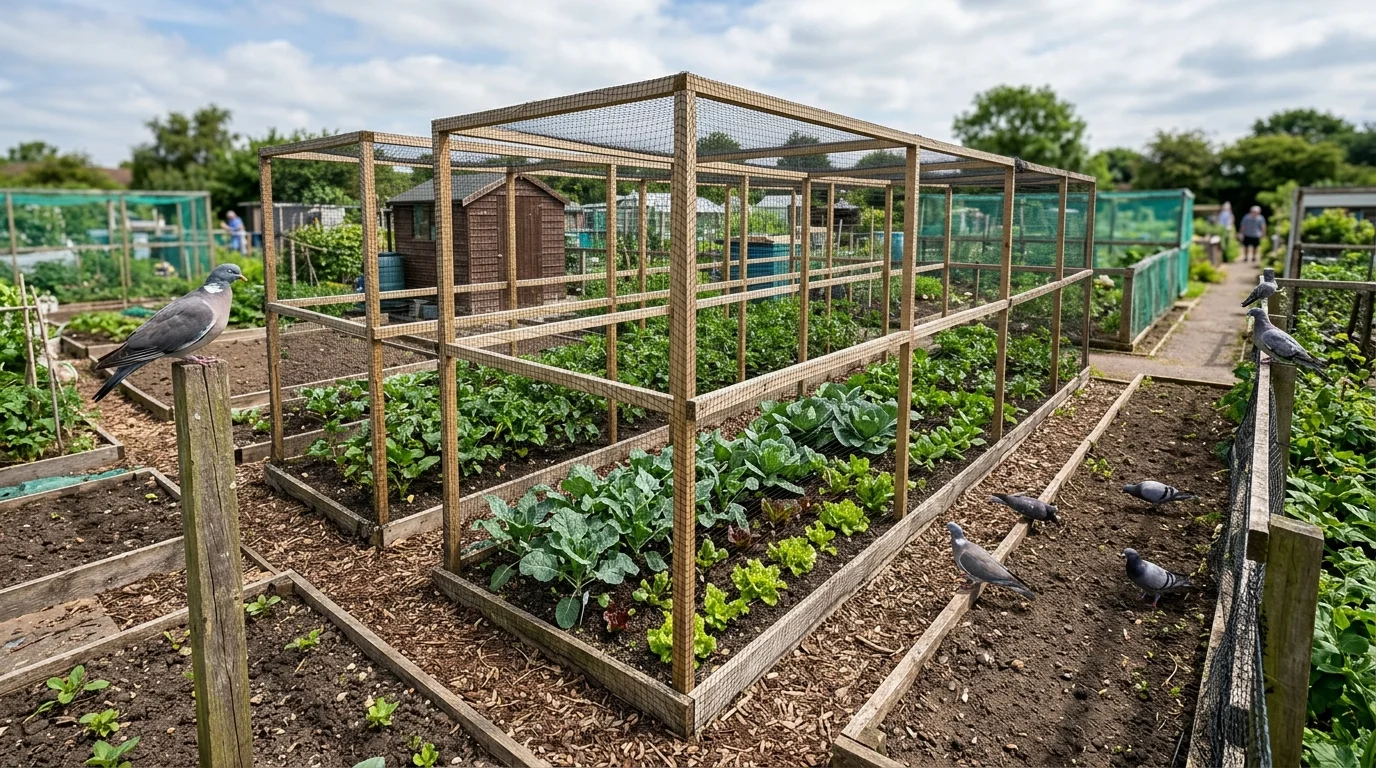
If you have the space and the budget, a permanent walk-in cage is the ultimate answer to ‘how to stop birds eating allotment crops’. I built one for my brassica bed two years ago. It is 3m x 2m x 1.8m tall, made with 22mm galvanised steel conduit and 19mm netting. Total cost was about £40. I can walk in, hoe, water, and harvest without kneeling. Pigeons sit on the roof and look at me with pure hatred.
Key construction tip for clay soil: Do not try to concrete the posts in. Use ‘spike base’ fittings—metal plates with a long spike that you hammer into the ground. They hold firm in heavy clay and allow you to move the cage if you rotate your brassica bed next year.
Companion Planting: Helpful, Not a Cure
I get asked constantly: ‘Will planting onions near my cabbages keep pigeons away?’ The answer is no. Pigeons are not deterred by smell the way carrot fly are. However, planting tall, dense crops like sunflowers or runner beans around the perimeter of your plot can create a visual screen. If a pigeon cannot see an easy landing spot, it might choose a neighbour’s plot instead. It is a small behavioural nudge, not a solution. Use netting.
What About Other Birds?
Pigeons are the main enemy for brassicas and peas. But finches and sparrows will target your lettuce and beetroot seedlings, and blackbirds will steal your strawberries. The same netting principle applies, but you can use a lighter structure. Fleece is a good alternative for seedlings—it blocks birds and frost, but you must remove it before the plants flower (to allow pollination).
For fruit bushes like currants and gooseberries, a dedicated fruit cage (netting over a wooden or metal frame) is the only way to stop blackbirds. A single blackbird can clear a redcurrant bush in one afternoon. Trust me.
The Bottom Line on Bird Control
Stop trying to trick them. You will not outsmart a pigeon. They have been evolving alongside scarecrows and flash tape for centuries. The only strategy that delivers a 100% success rate is a physical barrier that is taut, pegged down, and built to last.
For the New Plotter: Build a simple hoop cage for your first brassica bed. It takes one hour and saves you six weeks of heartache.
For the Thrifty Grower: Invest in a walk-in cage. It pays for itself in two years of saved crops.
For the Eco-Warrior: Buy knotted polypropylene netting and HDPE pipe. They are recyclable and will not harm wildlife.
Now get down to that plot, grab your pipe and pegs, and build a fortress. Your purple sprouting broccoli will thank you.
Frequently Asked Questions: Bird Control
- Will a fake owl or snake work? No. Birds habituate to static objects in under a week. They are effective for zero days.
- Can I use ultrasonic devices? Peer-reviewed studies from the University of Lincoln show no significant effect on pigeon feeding behaviour. Save your money.
- What mesh size do I need to stop sparrows? 19mm square mesh. Anything larger than 25mm allows sparrows and finches through.
- How do I stop birds getting into my fruit cage? Check all seams. Birds will find a 2cm gap. Use netting clips to seal edges against the frame. Ensure the door closes flush.