Stop the Bramble Brawl: How to Tame Blackberries in Small Fruit Cages
You’ve finally got your hands on a fruit cage—a neat, netted haven meant to protect your prize soft fruit from birds and wasps. You plant a blackberry cane, dreaming of autumn crumbles. Six months later, you open the cage door and are met with a hostile, thorny jungle that has crushed your raspberries, strangled the gooseberry bush, and is trying to escape through the netting. I’ve seen it happen time and again on my own allotment site.
Blackberries are nature’s thugs, pure and simple. They don’t ‘grow’, they ‘invade’. But that raw vigour is exactly what makes them such generous croppers come September, provided you treat them with the respect a bully deserves: firm boundaries, a strict training regime, and zero tolerance for sloppy growth. In this article, we’re going to deploy science-backed strategies to keep your blackberries productive and contained within a small cage, using thornless varieties, smart cane training, and robust fruit protection. Let’s get tactical.
Why Your Small Cage is a Prison, Not a Sanctuary (Unless You Manage It)
The classic mistake is thinking a fruit cage is a ‘set and forget’ solution. It’s not. In fact, a cage creates a perfect microclimate for blackberries: sheltered from wind, warmer in spring, and protected from the worst of the rain. All of this supercharges growth. Without a plan, you’ll face three specific pains:
1. The Netting Nightmare: Untrained canes grow fast and hard, poking through or pressing against the netting. You then have a thorny mess fused to the mesh, making harvesting a bloody misery and preventing you from opening the cage doors.
2. Disease Pressure: Poor airflow inside a crowded cage is a breeding ground for botrytis (grey mould) and cane spot. You need ventilation, not a dense thicket.
3. Harvesting Hell: A bramble that has self-tangled is a nightmare to pick from. Berries hide inside the mass, ripen unevenly, and are often eaten by earwigs and beetles that shelter in the tangle.
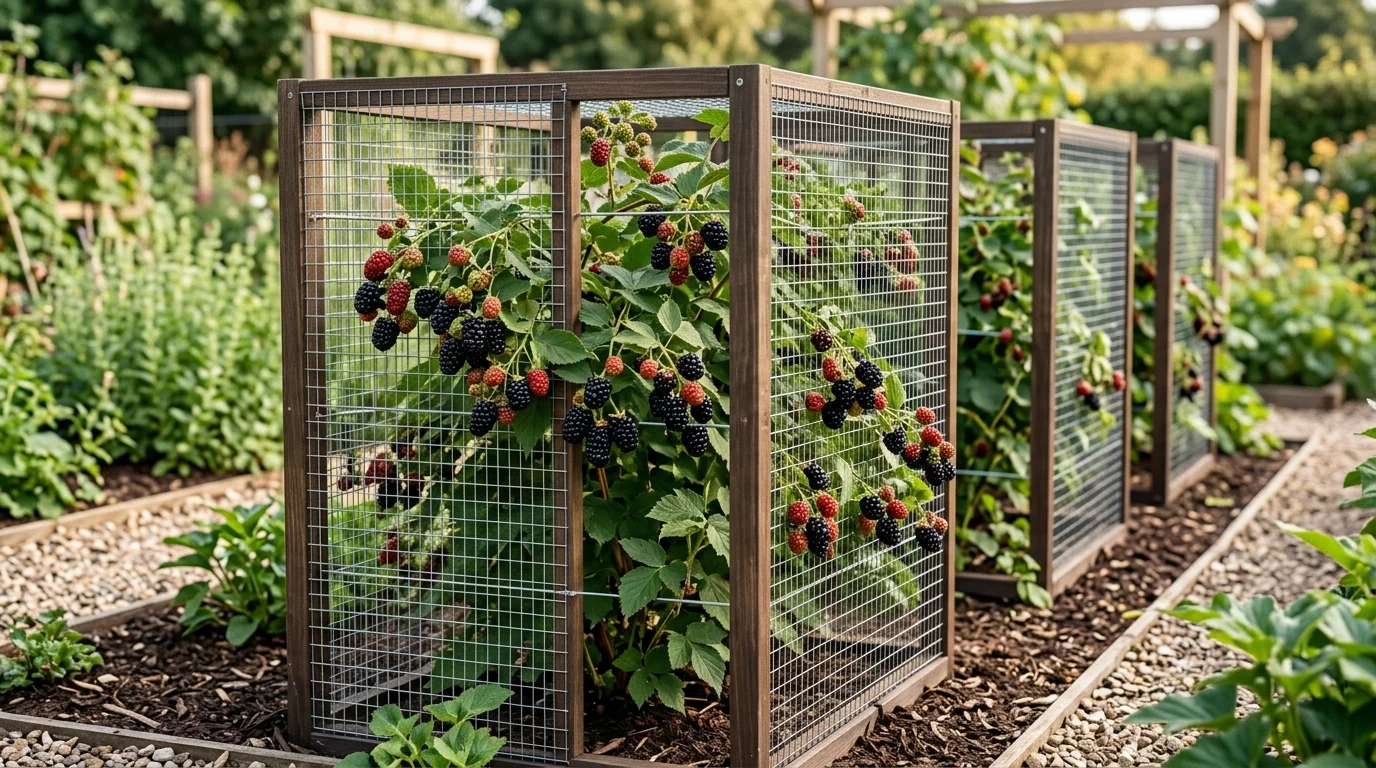
Solution: Treat the cage as a vertical trellis system, not a free-range enclosure. Every cane must be tied, trained, and terminated on your schedule. Here’s the blueprint.
Step 1: Choose Your Weapon – Thornless Varieties for Small Spaces
For a small cage, thornless cultivars are non-negotiable. Not only do they save your skin, they also produce canes that are far easier to guide along wires without catching on everything. The wild bramble (Rubus fruticosus agg.) is a magnificent plant, but it’s an allotment-scale commitment best left for a massive hedgerow. In a 6ft x 4ft cage, you need precision.
Based on RHS trials and my own Yorkshire plot, these three varieties outperform others in confined spaces:
| Variety | Thornless? | Flavour & Use | Cane Habit | Blight Resistance |
|---|---|---|---|---|
| Loch Ness | Yes (fully thornless) | Sweet, rich, heavy cropper. Perfect for jam and freezing. | Moderately vigorous, upright habit. Ideal for fan training. | Good resistance to cane spot and mildew. |
| Navaho | Yes (thornless) | Very sweet, firm berry. Excellent for fresh eating and desserts. | Upright and compact. Needs less horizontal space—great for narrow cages. | Good resistance to rust and cane blight. |
| Himalaya Giant (cultivated form) | No (thorny, but manageable) | Huge, aromatic berries with a true ‘wild’ tang. | Very vigorous. Only for experienced trainers who can keep up. | Moderate. Requires vigilant pruning for airflow. |
My pick for first-time cage growers: ‘Loch Ness’. It’s forgiving, produces reliably from July to September, and the upright habit means you can train it into a tidy fan against the back wall of your cage, leaving the front clear for accessing other crops.
Step 2: The Training System – The ‘One-Way Fan’ Method
Forget the traditional post-and-wire system you see in open fields. Inside a cage, you need a vertical plane system. Here’s the method I’ve refined over 15 years, which I call the ‘One-Way Fan’.
Materials:
– 2.5mm galvanised wire (plastic-coated optional, but avoid thin wire that cuts canes).
– Eye bolts or vine eyes screwed into the cage frame at 30cm and 90cm heights.
– Soft garden twine (biodegradable jute or polyethylene tape).
The Process:
- Year 1 – Establish the Base: Plant your single blackberry cane at the back-left corner of the cage (assuming you open the door from the front-right). Cut the cane down to 15cm after planting to encourage strong basal shoots.
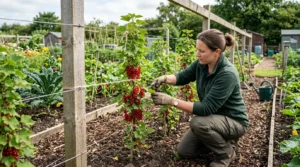
- Year 1 – Train the Primocanes: In summer, you’ll get 4-6 vigorous new canes (primocanes). Select the three strongest. Tie the first one to the 90cm wire, running it horizontally to the right across the back of the cage. Tie the second to the 30cm wire, also horizontally to the right. Tie the third vertically up the left side of the cage frame. The rest? Cut them off at ground level. No mercy.
- Year 2 & Beyond – The Fan: Last year’s horizontal canes (now floricanes) will fruit along their length this summer. Meanwhile, new primocanes will emerge from the base. Here’s the trick: only allow primocanes to grow on one side of the cage (the left side). Reroute any that try to go right. This creates a ‘one-way fan’—old fruiting canes on the right, new replacement canes on the left. After harvest, cut the old canes out completely, and tie the new ones into the vacant space.
This system keeps the centre of the cage open, gives you clear access to harvest, and ensures you never have a mix of old and new wood tangling together. It also dramatically improves airflow, slashing the risk of botrytis.
Critical note on cane tying: Use a figure-eight knot between the cane and the wire. Never tie the cane directly to the wire with a tight knot—it will strangle the cane as it thickens. The figure-eight allows a little movement and prevents girdling.
Step 3: Fruit Protection Inside the Cage – Beyond Bird Netting
You’ve built the cage to keep birds out, but blackberries inside a cage face different foes. With your fan system in place, you can now deploy targeted protection:
1. Slug and Snail Patrol: The damp, sheltered conditions inside a cage are a slug paradise. I use nematodes (Phasmarhabditis hermaphrodita) applied to the soil surface in early May and again in August. It’s a biological control that targets slugs underground, and it’s safe for wildlife. For surface slugs, a barrier of Vitax Slug Gone (wool pellets) around the base of the blackberry crown works well—slugs hate crossing it.
2. Earwigs: The Hidden Berry Thieves: Earwigs love to hide in the dense cane joints and chew small holes in ripe berries. The fix is simple: straw-filled upside-down flower pots on top of the cage corner posts. Earwigs will shelter in these instead of your canes. Empty the pots weekly into a bucket of soapy water, or relocate them far from the cage.
3. Botrytis (Grey Mould) Prevention: This fungal disease thrives on dead flowers and damaged fruit. With your fan system, inspect every cluster weekly. Snip out any berries that show a grey, fuzzy coating immediately. Do not compost infected fruit—bag it and bin it. Also, avoid overhead watering. Use a soaker hose or drip irrigation at the base of the canes to keep leaves and fruit dry.
Step 4: Pruning Calendar for Cage Control
To keep your blackberries in check, you need to prune three times a year. Mark these dates on your shed calendar:
- Early Spring (March): Remove any canes that have died over winter or show signs of cane spot (purple blotches). Thin remaining primocanes to three per plant.
- Mid-Summer (July, after main harvest): Cut out all floricanes that have just fruited. This is crucial—if you leave old wood, it will harbour disease and shade new growth. Cut them flush to the ground.
- Late Autumn (November): Shorten the tips of all new primocanes by 10-15cm. This encourages side branching, which increases next year’s fruit load, and stops the canes from hitting the cage netting and poking through.
A word on ‘tip rooting’: Blackberries naturally root where their cane tips touch the ground. Inside a cage, this means escape attempts. If you see a cane tip touching the soil, either cut it off or redirect it onto the wire. Otherwise, you’ll soon have a second plant growing where you don’t want it.
FAQ: Your Top Blackberry-in-a-Cage Questions Answered
Q: Can I grow wild blackberries from the hedgerow in my cage?
Technically yes, but I strongly advise against it. Wild blackberries (Rubus fruticosus agg.) are incredibly vigorous, aggressively thorny, and often carry soil-borne diseases like cane blight. They will quickly outgrow a small cage and become unmanageable. Stick to cultivated thornless varieties for sanity’s sake.
Q: My cage is only 4ft high. Can I still grow blackberries?
Yes, but you must adapt your training. Use the low horizontal wires at 30cm and 60cm height, and train the canes to run along these rather than growing vertical. You’ll get fewer, larger fruits rather than a huge quantity. ‘Navaho’ is the best choice for low cages due to its compact habit.
Q: How many blackberry plants can I fit in a 6ft x 4ft cage?
One. Just one. I know temptation is strong, but a single well-trained ‘Loch Ness’ will fill that space and produce 3-5kg of fruit per year. Two plants will create a traffic jam. For a 8ft x 6ft cage, you could squeeze two plants on opposite ends, but keep 4ft between them.
Q: My blackberry flowers but never sets fruit. What’s wrong?
Likely a lack of pollination. Fruit cages can exclude bees if netting is too fine (use 1-inch mesh). Also, blackberries are self-fertile but benefit from insect activity. In cold, wet springs, hand-pollinate with a soft brush. Gently dab each flower cluster—this can double your yield.
The Final Word: Grow Smarter, Not Harder
A small fruit cage doesn’t have to be a wilderness of thorns. By choosing a thornless variety like ‘Loch Ness’, implementing the One-Way Fan training system, and staying on top of a three-pronged pruning schedule, you can turn your cage into a high-yield, low-stress production unit. The key is to remember that blackberries are just big babies that need clear rules and boundaries. Give them that, and they’ll reward you with bucketloads of glossy, sweet fruit that make those supermarket punnets taste like cardboard.
For further reading on blackberry cultivation and disease resistance, I recommend the RHS guide to growing blackberries and the Garden Organic advice on fruit care. Now go tame that bramble!