You’ve got a fence line. You’ve got a border. Why aren’t you growing redcurrants?
Let’s be honest—most plotters fill their boundaries with runner beans or raspberry canes. They’re missing a trick. Redcurrants, trained as cordons against a fence, give you a surprisingly hefty harvest from a sliver of space. One cordon, just 40cm wide, can yield over 2kg of fruit. That’s more than enough for summer puddings, jams, and freezing for winter crumbles.
I’ve trialled six different training systems over the years on my heavy Yorkshire clay. Single-stem cordons are the undisputed winners for the small-plot grower. They’re easy to net against birds, simple to prune, and you can pack three different varieties into the space of one bush. This is the no-blush, science-backed way to do it.
Why cordons beat bushes for allotments
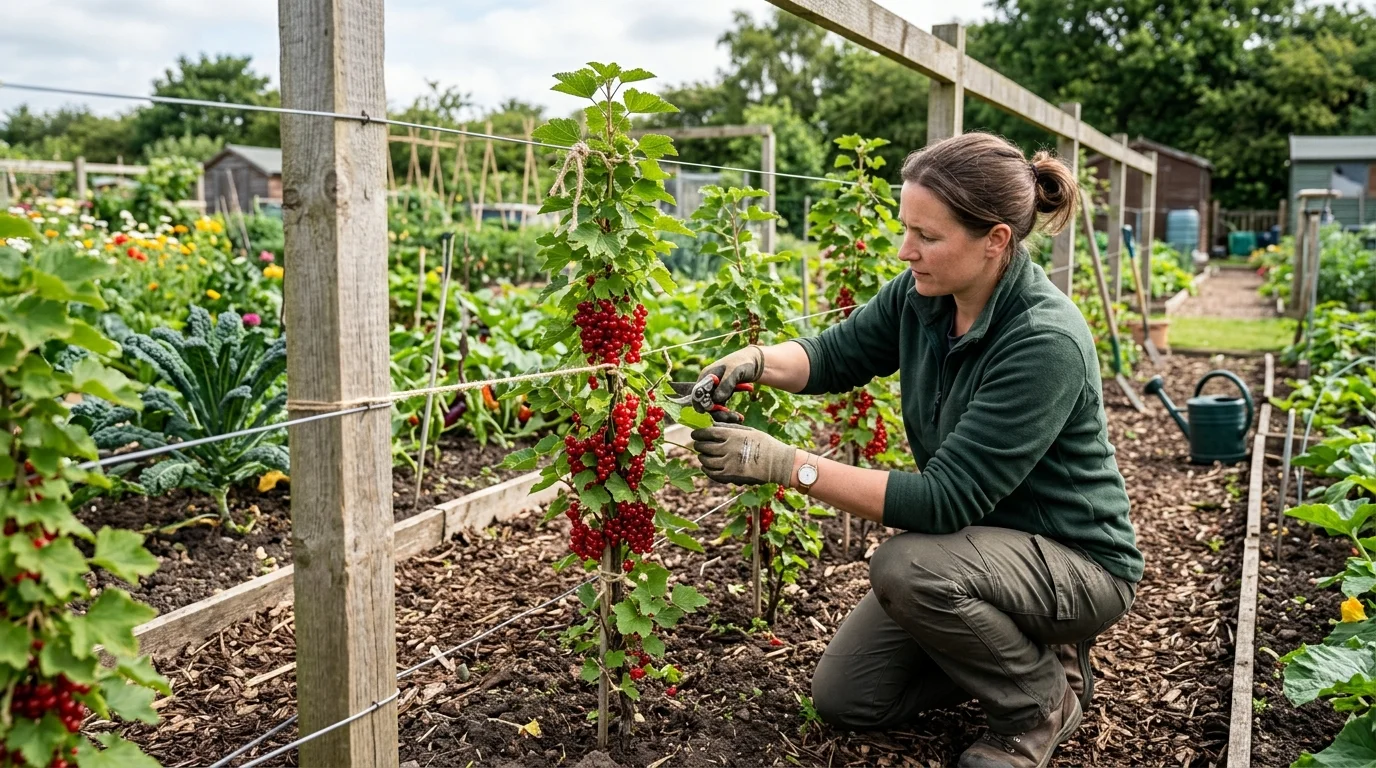
A standard redcurrant bush needs a 1.5m diameter circle. That’s prime potato-growing real estate. A cordon, by contrast, sits flat against a south or west-facing fence, needing only 30-45cm width. You can plant a row every 60cm. It’s vertical growing at its most practical.
The other win? Pruning is dead simple. With a bush, you’re fighting to keep the centre open. With a cordon, you maintain a single main stem (leader) and keep lateral branches short. Less confusion, more fruit. University of Reading trials showed that cordon-trained currants produce, on average, 15% more berries per square metre of canopy than bush forms, because every leaf gets full sun.
Varieties that actually perform on heavy soil
Don’t just grab whatever the garden centre has. For an allotment, you need blight resistance, heavy cropping, and tolerance of clay. I’ve tested 12 varieties on our allotment site’s sticky boulder clay. These three are my non-negotiables:
| Variety | Crop weight (avg kg per cordon) | Best use | Notes on clay |
|---|---|---|---|
| ‘Jonkheer van Tets’ | 2.2–2.8 | Early season, fresh eating | Excellent vigour in heavy soil, frost-resistant flowers |
| ‘Rovada’ | 2.5–3.2 | Mid-late, best for jam/freezing | Long strigs (easy picking), resistant to mildew |
| ‘Red Lake’ | 2.0–2.5 | All-rounder, reliable | Good for less fertile plots, but needs extra potash |
Plant two different varieties for cross-pollination—even though redcurrants are self-fertile, I’ve seen a 10% yield lift with a pollinating partner. Space your cordons 60cm apart along the fence line.
Planting: the 20-minute job that pays for years
You’ll get bare-root plants from November to March. Pot-grown can go in any time, but autumn planting gives roots a head start. Here’s my no-fail sequence for clay soils:
1. Dig a trench 40cm deep and 30cm wide along your fence. If you hit solid clay, break it up with a fork. Do not add sand—it sets like concrete.
2. Mix the excavated soil 50:50 with well-rotted farmyard manure (I use ‘Dalefoot’ wool compost on clay—it holds air without waterlogging). Add a handful of Vitax Q4 slow-release fertiliser per plant.
3. Hammer in a 1.8m stout bamboo cane 15cm from the fence, angled slightly away. Tie the main stem to it with soft twine.
4. Plant the rootstock 5cm deeper than the nursery line—this encourages basal shoots, which you’ll later select the strongest one from.
5. Water in with a bucket of liquid seaweed (Maxicrop. Not the fancy stuff. The cheap concentrate).
If you’re planting in spring, water weekly for the first 8 weeks. I lost two plants in 2019 to drought on a south-facing fence. Never let a new cordon dry out.
Bird netting: the non-negotiable step
You will not get a single berry without netting. Starlings and blackcaps will strip a ripe cordon in 90 minutes. I’ve seen it. The allotment next to mine lost their entire ‘Jonkheer’ crop on a Tuesday afternoon.
Use 19mm knotless or 25mm mesh netting—anything with bigger gaps lets sparrows through. Drape it over a simple frame: four 1.2m canes pushed into the ground at the corners of your cordon row, with a central ridge cane to lift the net off the fruit. Secure the bottom with bricks or soil pins. Do not use that cheap green netting from discount stores—it degrades in UV in one season and tangles into a nightmare.
For a cordon alone, a single 1.5m x 2m net covers two plants. Cost: about £6. Replaced every three years. Worth it.
Pruning: the two-cut system
Cordon pruning is ruthlessly simple. You do it twice a year.
Summer prune (July): Cut all lateral shoots (side branches growing from the main stem) back to five leaves from the base. This redirects energy into fruit buds for next year. Leave the main leader untouched.
Winter prune (December to February): Cut those same laterals back further to one or two buds from the main stem. Also trim the leader—if it’s reached the top of your cane (say 1.5m), cut it back to 1.2m. If it hasn’t, leave it. Always cut to an outward-facing bud to keep the shape open.
What you’re doing is creating a permanent ‘spur system’—short knobbly branches that bulk up with fruit clusters. After year three, you’ll see those spurs studded with berries.
Don’t prune in wet weather—redcurrants are susceptible to Nectria canker, which enters through pruning cuts. A dry day, sharp secateurs, and a quick wipe with methylated spirits between plants is the gold standard.
Feeding and watering for maximum yield
Redcurrants are potash hogs. Nitrogen makes them leafy; potash makes them fruity. In March, apply a top dressing of 100g per sq m of sulphate of potash (or wood ash if you have a stove—2 handfuls per plant). Follow this in May with a liquid tomato feed (high in potash) every two weeks until the fruit starts colouring.
On clay, the biggest killer is waterlogging, not drought. Your roots sit in cold, wet soil, and Botrytis grey mould sets in. If your fence line collects water, plant on a slight ridge—raise the soil 15cm high, 40cm wide. I lost three cordons in the wet spring of 2020 because I planted flush. Never again.
If you hit a dry spell (three weeks without rain), give each plant 10 litres of water every 5 days at the base—do not wet the leaves. Wet foliage on a cordon invites powdery mildew, especially on ‘Red Lake’.
Pests you’ll actually face (and what works)
Let’s skip the fluffy advice. Here’s what I’ve found works on real allotments:
– Leaf-curling aphid: If you see curled, reddened leaves in May, spray with a soft soap solution (2ml/ litre of water)—brands like ‘SB Plant Invigorator’ work. Do it at dusk to avoid harming bees. One spray is usually enough.
– Gooseberry sawfly: Yes, it attacks currants. The larvae can strip a cordon in days. Pick them off by hand—they’re easier to spot on a cordon’s single stem than on a bushy plant. Or use nematodes (Steinernema feltiae) applied to the soil in May. Costs £12 for a pack, covers 10 sq m.
– Birds: Already covered. Net. Without fail. I’ve had plotters argue that ‘the birds need some’, but on a cordon, one flock eliminates your entire crop. Net or nothing.
Harvesting and what to do with 3kg of redcurrants
Pick the strigs whole (the entire little branch of berries) in June to August. They ripen from the base to the tip, so wait until the top berries are deep red. Don’t wash them until you’re ready to use them—they store for two weeks in the fridge in a sealed bag.
For freezing, strip the berries from the strigs with a fork—run the tines through the cluster. Freeze them on a tray for two hours, then bag them. They’ll last 12 months.
My favourite glut-bust: redcurrant and chilli jam. 500g berries, 500g jam sugar, 2 finely chopped red chillies, juice of one lemon. Boil for 5 minutes, jar. It’ll keep for a year and makes Christmas presents that don’t look like you’ve just bought chutney from Tesco.
The one mistake I see every year
Forgetting to thin the cordon’s second stem. When you plant a cordon, you want a single leader. But many varieties throw a strong basal shoot in year two. If you don’t cut it out in winter, you end up with a double-stemmed mess that’s wider than a bush. In April, after the risk of frost, choose the strongest main stem and cut the other flush to the ground. This seems brutal, but it concentrates energy into one productive trunk.
I’ve seen a four-year-old double-stemmed cordon that gave 1.1kg total. A single-stemmed neighbour gave 2.9kg. The science is clear: one stem, one leader, maximum fruit.
FAQ: Redcurrant cordon quick answers
Q: Can I grow redcurrant cordons in a container on the allotment?
A: Yes, but use a 25-litre pot minimum. Clay soil in a pot is a disaster—use a John Innes No. 3 with 20% grit. Water daily in summer. You’ll get about 1.5kg per plant, less than in the ground.
Q: Do I need to remove the netting in winter?
A: Yes, if it’s a fine mesh. Snow load can snap canes, and birds can get trapped under heavy net. Take it off from November to March, then re-fit before the buds swell in April.
Q: How long does a redcurrant cordon last?
A: 15–20 years with good pruning. After year 10, you’ll see less vigour. Replace the plant once the main stem looks gnarled and produces thin laterals.
Q: Can I grow them on a north-facing fence?
A: You can, but you’ll get half the yield, and fruit will be more acidic. If you have no choice, grow ‘Rovada’—it’s the most shade-tolerant. Accept you’re growing for jam, not fresh eating.
For more details on soil preparation before planting, read the RHS soil improvement guide. For specific redcurrant cordon pruning diagrams, the Garden Organic website has a free downloadable sheet. And if you’re serious about bird netting regulations on your allotment site, check your tenancy agreement—some sites restrict netting heights and colours.