You’ve cleared your plot, planted your first spuds, and then you see it: a prehistoric-looking green spike pushing through your lovingly prepared soil. That’s horsetail, or marestail, and it’s not a weed—it’s a survivor from the Carboniferous period.
If you’re trying to control marestail on an allotment, you’ve likely already discovered that pulling it is a waste of time. This plant has roots that plunge up to two metres deep, plus a network of rhizomes that can regrow from a fragment the size of your thumbnail. It’s not a battle you win in a season, but it is one you can manage. I’ve dealt with this on heavy Yorkshire clay for years, and the key is understanding its biology—then outsmarting it.
Let’s strip away the romanticism. Horsetail (Equisetum arvense) thrives on disturbed, compacted, or poorly drained soil. It’s a bioindicator of compaction and low fertility. The good news? That means we can fix the conditions it loves. The bad news? Deep roots mean no quick fix.
Why Horsetail is So Tough: The Biology of a Survivor
Before we talk tactics, you need to respect what you’re dealing with. Horsetail is a living fossil that has survived for over 300 million years. It spreads via two methods:
- Spores: Brown, cone-like stems appear in spring, releasing thousands of dust-like spores that can travel on the wind. They don’t germinate in established turf, but on bare soil they’re a problem.
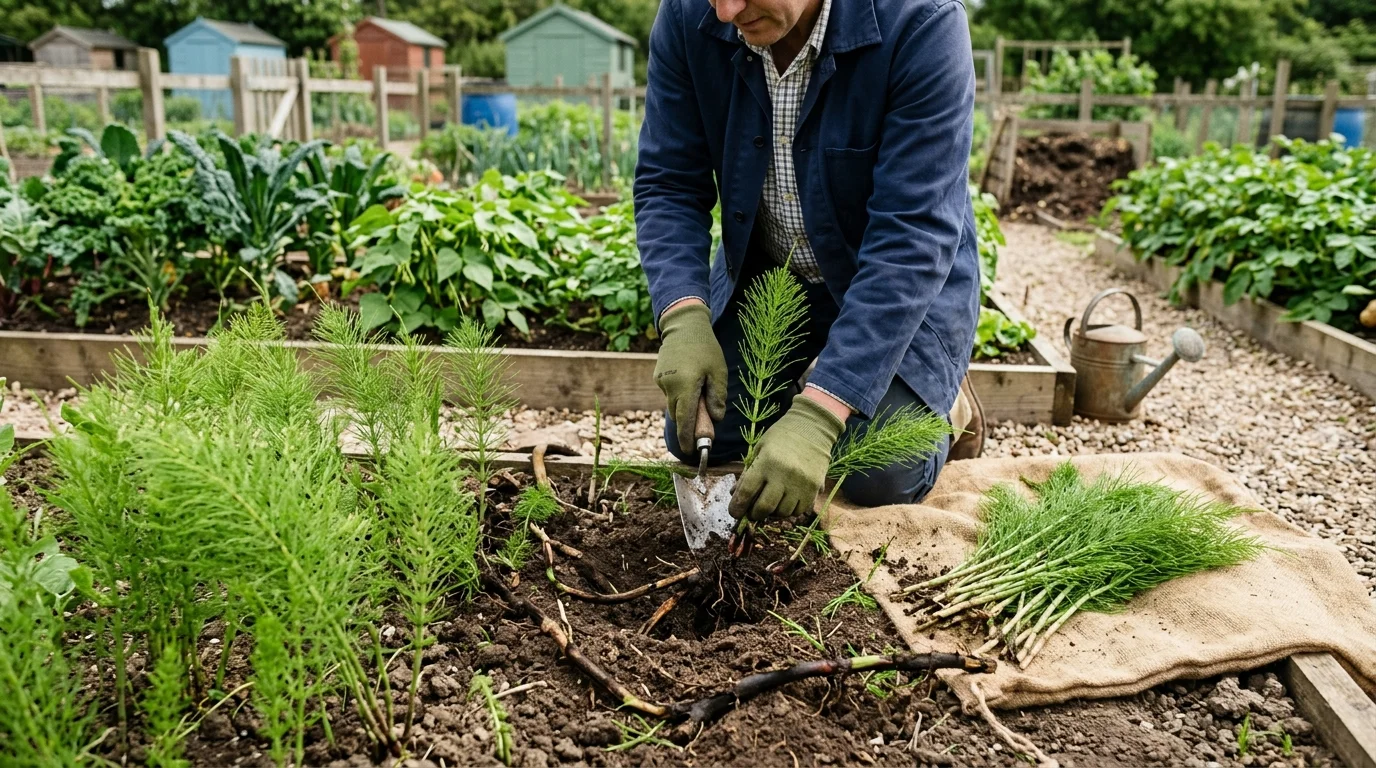
- Rhizomes and tubers: The main root system can reach 2 metres deep. Side rhizomes store energy in small black tubers. Even a 1cm fragment can regenerate.
Most gardeners make the mistake of pulling the green stems. This actually strengthens the plant because it forces the root system to send up more shoots, depleting your energy while the horsetail stores more underground. Crushing stems rather than pulling is a smarter first step—it damages the vascular system without triggering regrowth hormones.
Strategy 1: Starve the Root System (The Long Game)
The only way to truly control marestail on an allotment is to exhaust the deep root reserves. This takes 2-4 years of consistent effort. Here’s the phased plan:
Year 1: Suppression and Smothering
- Cut, don’t pull. Use a sharp hoe or shears to cut stems at ground level every 2-3 weeks during the growing season. This prevents photosynthesis from feeding the roots.
- Crush stems with a roller or board after cutting. This bruises the tissue and reduces regrowth vigour.
- Smother with thick mulch. Lay down 6 layers of wet cardboard, then 15-20cm of organic matter (well-rotted manure or wood chip). This blocks light and physically suppresses shoots.
- Improve drainage. Horsetail loves wet, compacted clay. Dig in grit or sharp sand (10-15 litres per square metre) and consider raised beds to improve aeration.
Year 2: Competition and Cultivation
- Plant a green manure. Strong-growing species like buckwheat or phacelia will outcompete horsetail for light and nutrients. Avoid deep-rooted green manures that could break up the rhizomes.
- Use a no-dig approach. Digging spreads rhizome fragments. Instead, add 5cm of compost on top of your mulch annually. The worms will incorporate it.
- Targeted hoeing. If shoots appear, cut them at the soil line. Never rotavate—it’s a disaster.
Year 3 and beyond: Root Exhaustion
- Many plotters give up after a year. Don’t. The roots have massive energy stores. It takes 3-4 years of constant stem removal to deplete them.
- Once stems become thin and sparse, you can start planting deep-rooted perennials like asparagus or fruit bushes. Their root systems will compete with horsetail.
Strategy 2: Chemical Control (Only as a Last Resort)
I’m not anti-chemical, but I’m evidence-led. On an allotment, you have to be careful. Most broad-spectrum weedkillers don’t touch horsetail because of its waxy cuticle and deep roots.
| Chemical | Efficacy on Horsetail | Notes for Allotments |
|---|---|---|
| Glyphosate (e.g., Roundup) | Low to moderate | Only effective if applied to young, soft growth in May. Needs repeated applications. Avoid drift onto crops. |
| 2,4-D (e.g., SBK) | Moderate | Selective broadleaf killer. Can reduce top growth but won’t kill deep roots. Use only on paths or non-cropped areas. |
| Ammonium sulphamate (e.g., Rootblast) | Higher | Breaks down in soil quickly. Effective on horsetail but must be applied to actively growing stems. Not organic. |
If you choose chemical control, do it in late spring when the stems are fully unfurled but still green and soft. This is when the plant is moving energy down to the roots. Apply on a dry, calm day and don’t water for 48 hours. You’ll need to repeat at least twice.
Strategy 3: Biological and Cultural Tactics
For the eco-warriors among you, there are peer-reviewed organic options. RHS trials show that:
- Nematode applications (specific strains of Steinernema feltiae) can reduce horsetail vigour by parasitising the roots, but don’t expect eradication.
- Competitive planting with dense ground cover (e.g., clover, creeping thyme) limits spore germination.
- Calcium and lime: Horsetail prefers acidic soils (pH 5.5-6.5). RHS research indicates that raising pH to 7.0-7.5 with garden lime (500g per sq m annually) slows its growth. It won’t kill it, but it reduces vigour.
One trick I’ve used successfully: cover affected areas with black polythene for a full year. It’s ugly, but it blocks all light. After 12 months, the top 30cm of roots will die back. The deep roots survive, so you’ll still get shoots when you remove it, but they’ll be weaker.
Common Mistakes That Make Marestail Worse
I’ve seen plotters do more harm than good. Avoid these:
- Rotavating or deep digging. This spreads rhizome fragments everywhere. You’ll turn a small patch into an infestation.
- Pulling stems. This breaks them off at weak points, leaving root fragments that regrow stronger.
- Applying weedkiller too late. Once stems turn brown in autumn, the plant isn’t translocating chemicals to the roots.
- Ignoring the soil. If you don’t improve drainage and fertility, horsetail will keep coming back.
FAQ: Your Horsetail Questions Answered
Can I compost horsetail stems?
Only if you let them dry out completely for several weeks first. Fresh stems can root in the compost pile. Better to solarise them in a black bag for 3 months before adding.
Will horsetail grow through paving slabs?
Yes. The rhizomes are strong enough to crack concrete over time. Smothering with thick mulch on paths is more effective than trying to dig them out.
Is horsetail edible or useful?
It contains silica and has been used as a medicinal tea, but I don’t recommend foraging from an allotment due to potential pesticide residue. The sterile green stems can be used as a gentle scouring pad for pots.
How long does it take to eradicate?
Realistically, 3-5 years of consistent suppression. You won’t eliminate it, but you can reduce it to a few weak stems per square metre. Think management, not eradication.
The Bottom Line: Patience Beats Power
Controlling marestail on an allotment is a test of persistence, not strength. The plant evolved before dinosaurs—it’s not going to give up in one season. Focus on:
- Cutting and crushing stems every 2-3 weeks during spring and summer.
- Smothering with light-proof mulch (cardboard + wood chip) for at least a year.
- Improving soil drainage and raising pH with lime.
- Avoiding any digging or rotavation that spreads root fragments.
You don’t have to win overnight. You just have to outlast it. And with a solid, science-backed plan, you will.
For more detailed guidance, check the RHS horsetail advice page or the Garden Organic fact sheet. And if you’re part of an allotment association, consider a plot-wide approach—horsetail doesn’t respect boundaries.