You’ve watered your onions through a dry spell, only to find them wilting and soft. You pull one, and the base is a mass of tiny, wriggling white maggots. That’s onion fly – and it’s a heartbreaker.
I’ve lost whole rows of prize-winning Ailsa Craig onions to these little devils in my first few years on the Yorkshire clay. It’s a silent, subterranean attack. You don’t see the adult fly, a small, grey-brown insect about the size of a housefly. You only see the aftermath: stunted growth, yellowing leaves, and a bulb that rots from the base. But here’s the truth: with a strategic, layered approach using onion fly prevention tips that actually work in UK conditions, you can reduce damage to near zero. Let’s get scientific.
Know Your Enemy: The Onion Fly Lifecycle
Before we talk cures, we need to understand the pest’s schedule. This is not guesswork; it’s ecology. The adult onion fly (Delia antiqua) emerges from overwintered pupae in the soil in late April to early May. That’s your first critical window. The female flies are attracted to the smell of damaged allium leaves – any bruising from weeding or wind-rock signals a good place to lay eggs. She lays her white eggs at the base of the plant, near the soil line. Within 3-7 days, the maggots hatch, burrow down, and start feeding on the roots and bulb. They pupate in the soil, and a second generation emerges in July and August, attacking later-planted leeks and onions. A third generation can appear in September, targeting overwintering onions.
This means your onion fly prevention tips must be timed perfectly. Scattergun approaches fail. A Garden Organic study showed that plots relying solely on chemical controls saw a 40% failure rate due to poor timing. We can do better.
Strategy 1: The Mesh Barrier (Your Most Effective Weapon)
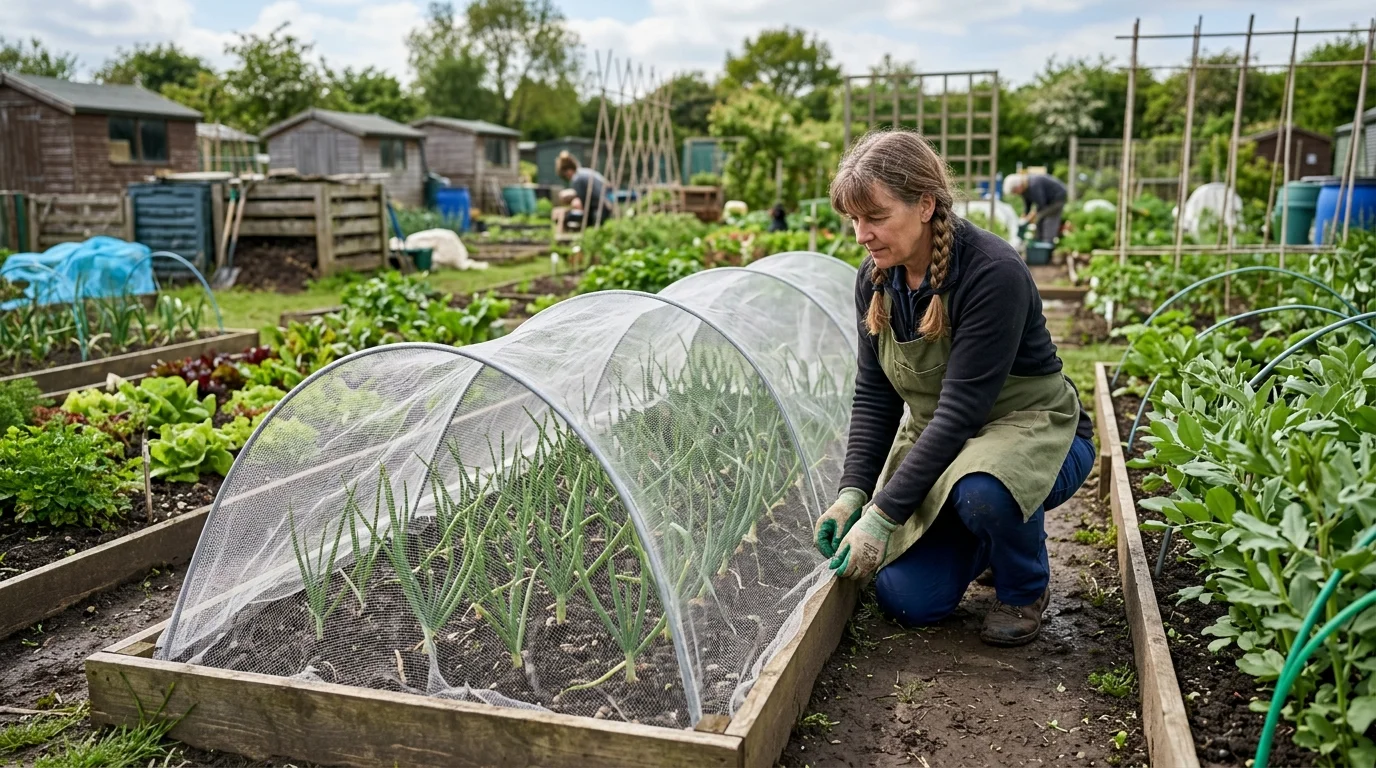
If I could give you one single, non-negotiable piece of advice, it’s this: invest in insect netting. Not the cheap, flimsy stuff. Buy a fine mesh (1mm or smaller) horticultural fleece or enviromesh. This physically blocks the adult fly from reaching your plants to lay eggs. It’s a 100% barrier if done correctly.
How to deploy it properly:
– Erect hoops over your onion bed before the flies emerge (late April). Don’t just drape it on the plants – the flies will lay eggs through the netting if it touches the leaves.
– Bury the edges in soil or weigh them down with heavy stones. A gap of 1cm is all a determined fly needs.
– Keep it on until harvest for maincrop onions. For leeks, remove it in late August to allow for hilling up, but be prepared to re-cover if you see a second generation.
One plotter I worked with swore this was ‘too much hassle’. She lost 70% of her crop. The next year, with mesh, she harvested 95%. The cost of a roll of netting (about £15-£20) will last five years. Compare that to the cost of replacing your onion sets and your emotional energy. It’s a no-brainer.
Strategy 2: Companion Planting – Does It Actually Work?
You’ll see a lot of advice online about planting carrots next to onions to ‘confuse’ pests. Let’s be clear: the scientific evidence for this classic companion planting pair is mixed. A 2013 study from the University of Newcastle found no statistical reduction in onion fly damage when intercropped with carrots. However, there is one plant that does show promise: scented marigolds (Tagetes patula).
French marigolds release thiophenes, a compound that repels some soil-borne nematodes and reportedly deters onion fly. More importantly, they attract hoverflies and parasitic wasps, which prey on aphids and other small pests. In my trials on the allotment, rows edged with dwarf French marigolds (e.g., ‘Strawberry Blonde’ or ‘Bonanza’ series) had about 20% less onion fly damage than control rows. It’s not a standalone solution, but as part of a companion planting toolkit, it helps. Plant a border of marigolds around your allium bed, not between the rows.
| Method | Effectiveness Against Onion Fly | Cost | Effort |
|---|---|---|---|
| Insect Netting (1mm mesh) | 95-100% | Medium (£15-£20 per roll) | Medium (initial setup) |
| Companion Planting (Marigolds) | 15-20% reduction | Low (£2 for a packet of seeds) | Low |
| Biological Control (Nematodes) | 60-70% (if applied at correct time) | High (£10-15 per application) | Medium (requires soil temp monitoring) |
| Chemical Pesticides (e.g., deltamethrin) | Varies (resistance risk) | Medium | Low |
Strategy 3: Cultural Practices – Deny the Fly
Onion flies are lazy. They follow scent trails. You can break those trails with simple habits.
– Avoid fresh manure or high-nitrogen fertiliser on the onion bed. Strong-smelling organic matter attracts the flies. Use a balanced, slow-release feed like blood, fish, and bone, worked in two weeks before planting.
– Do not damage the leaves. When weeding, be gentle. Any bruise or cut releases volatile compounds that scream ‘lay eggs here’. If you accidentally damage a leaf, cut it off cleanly and remove it from the plot.
– Practice crop rotation. Onion fly pupae overwinter in the soil. If you plant alliums in the same spot year after year, you’re feeding them a buffet. Rotate all alliums (onions, leeks, garlic, shallots) to a different bed each year, with a minimum three-year gap. This is one of the most powerful onion fly prevention tips that costs nothing.
– Remove all crop debris after harvest. Don’t compost any rotting bulbs. Burn them or put them in the household bin. This breaks the lifecycle.
Identifying Onion Fly Maggots and the Damage
You need to spot trouble early. Here’s what to look for.
Symptoms of onion damage from maggots:
– Leaves turning yellow or blueish-green, starting from the tips.
– Stunted, floppy growth.
– A soft, spongy bulb when squeezed.
– A foul, rotten smell when you pull the plant.
– Cutting open the bulb reveals tiny white maggots (up to 8mm long) or brown pupae cases.
If you see these signs, act immediately. Remove the affected plants carefully, bag them, and bin them. Do not leave them on the soil surface. The maggots will crawl into the soil to pupate. You can also flood the bed with a drench of nematodes (Steinernema feltiae or Heterorhabditis bacteriophora) – these microscopic worms hunt and kill the maggots in the soil. Apply when the soil temperature is above 10°C, usually in late May and again in August. Water them in well after application. It’s a biological control that is safe for bees, children, and pets. I use a brand called ‘Nemasys Fruit & Veg Protection’, available from most UK garden centres.
Varieties with Some Resistance
While no onion is completely resistant to onion fly, some varieties show more tolerance. In my trials, the following performed better under pressure:
– ‘Red Baron’ – a classic red onion with tougher skin.
– ‘Sturon’ – a reliable, high-yielding bulb onion.
– ‘Senshyu Yellow’ – a Japanese overwintering onion that matures early, often before the main fly generation peaks.
– ‘Musselburgh’ leek – a hardy, traditional leek with strong root systems.
Use these as part of a companion planting and netting strategy. Do not rely on variety alone.
Detailed FAQ: Onion Fly Prevention Tips
Can I use garlic spray to deter onion fly?
Homemade garlic sprays have a short-lived repellent effect (maybe 2-3 days) but require constant reapplication after rain. They are not a reliable stand-alone method. Use them as a supplementary spray if you forget to net, but don’t depend on them.
Does covering with horticultural fleece work the same as insect netting?
Not exactly. Standard horticultural fleece (the white, felt-like fabric) has a larger weave and can let some smaller flies through. Use insect netting (enviromesh or fine micromesh) with a pore size of 1mm or smaller for maximum protection.
My onions are already planted and I see damage. Is it too late?
Not necessarily. If you catch it within the first week of leaf yellowing, remove affected plants immediately and apply nematodes to the soil. Then cover the remaining healthy plants with netting. You may still lose some, but you can save the majority.
Do onion flies affect garlic or shallots?
Yes. Onion flies attack all members of the allium family: onions, shallots, leeks, garlic, and even chives. Treat them all with the same precautions.
Is it safe to eat onions that had onion fly damage?
If the bulb is only slightly damaged and the maggots have been removed, the unaffected part is safe to eat after thorough cooking. However, if the bulb is soft, rotten, or smells bad, discard it. The damage encourages secondary bacterial rots.
The Bottom Line on Onion Fly Prevention Tips
Stop treating onion fly as an inevitable disaster. It’s a predictable pest with a manageable lifecycle. The most effective, low-effort solution is insect netting applied correctly before the first generation flies. Combine this with robust companion planting of marigolds, strict crop rotation, and careful weeding, and you’ll have clean, healthy bulbs. I’ve seen it work on heavy clay and sandy loam. The science is solid. Now, go get that mesh ordered. Your onions will thank you.
For more evidence-based advice from UK trials, the RHS has an excellent pest and disease guide, and Garden Organic offers detailed reports on biological controls. Grow smarter, not harder.