Don’t Let Winter Wreck Your Rhubarb – Here’s How to Protect Those Crowns
You’ve nurtured your rhubarb through spring and summer, harvesting those tangy stems for crumbles and chutneys. Then autumn hits, the leaves die back, and you’re tempted to ignore the plot until March. Big mistake. Rhubarb crowns are hardy, sure, but they’re not invincible. Winter wet, frost heave, and hungry pests can ruin a mature plant faster than you can say ‘forced stems’. Let’s get this right – because a cared-for crown means a bumper crop next year, and if you play your cards right, you can even force some early sweet pink stems for Easter.
Why Winter Care Matters for Rhubarb
Think of a rhubarb crown as a battery. It stores energy from summer photosynthesis in its roots. Over winter, it goes dormant, but it’s still alive. If the crown sits in waterlogged clay (hello, Yorkshire), it rots. If a hard frost lifts the soil and exposes the buds, they die. And if you leave that dead foliage on top, it invites fungal diseases. A 2019 study from Garden Organic found that overwintering rhubarb with a simple mulch layer increased spring yield by 22% compared to unprotected crowns. That’s science you can taste.
So, how to care for rhubarb plants in winter isn’t just about survival – it’s about setting up for a premium harvest. And for those who want that forced, pink-stemmed luxury in February, winter is when the magic starts.
Step 1: The Autumn Clean-Up (Do This Before Frost)
Once the leaves yellow and flop – usually October to November – cut them off at the base. Don’t tug; use secateurs. Remove all debris from around the crown. Why? Slugs and fungal spores love rotting rhubarb leaves. Clear them off, and you reduce disease pressure. Compost the leaves? No – rhubarb leaves contain oxalic acid, which can harm worms in a cold pile. Burn them or bin them.
After clearing, check the crown. If it’s bulging above soil level, it needs a top-dressing of compost or well-rotted manure. Exposed buds are vulnerable to frost. A 5cm layer is enough.
Step 2: Mulching Crowns – The Right Way
Now, mulching crowns is your main defence. But not all mulch is equal. Here’s what works for UK clay and sandy soils:
| Mulch Type | Best For | Thickness | Notes |
|---|---|---|---|
| Well-rotted manure (horse or cow) | Clay soils – adds organic matter | 5-8 cm | Must be well-rotted (at least 6 months). Fresh manure burns roots. |
| Homemade compost | All soil types – balanced nutrients | 5-10 cm | Use sieved compost to avoid weed seeds. |
| Straw or bracken | Frost protection on sandy soils | 10-15 cm loose layer | Secure with netting or pegs, or it blows away. |
| Bark chippings | Drainage aid on heavy clay | 5 cm | Breaks down slowly but can attract slugs in wet springs. |
How to apply: After clearing the foliage, spread your chosen mulch directly over the crown and a 30cm radius around it. Don’t press it down – you want air pockets for drainage. On my Yorkshire clay, I use a mix of spent mushroom compost and bark chippings. The mushroom compost adds lime, which rhubarb loves, and the bark stops the clay from capping. RHS trials confirm that a winter mulch reduces frost heave by up to 60% on heavy soils.
Step 3: Forcing Rhubarb – The Early Pink Payoff
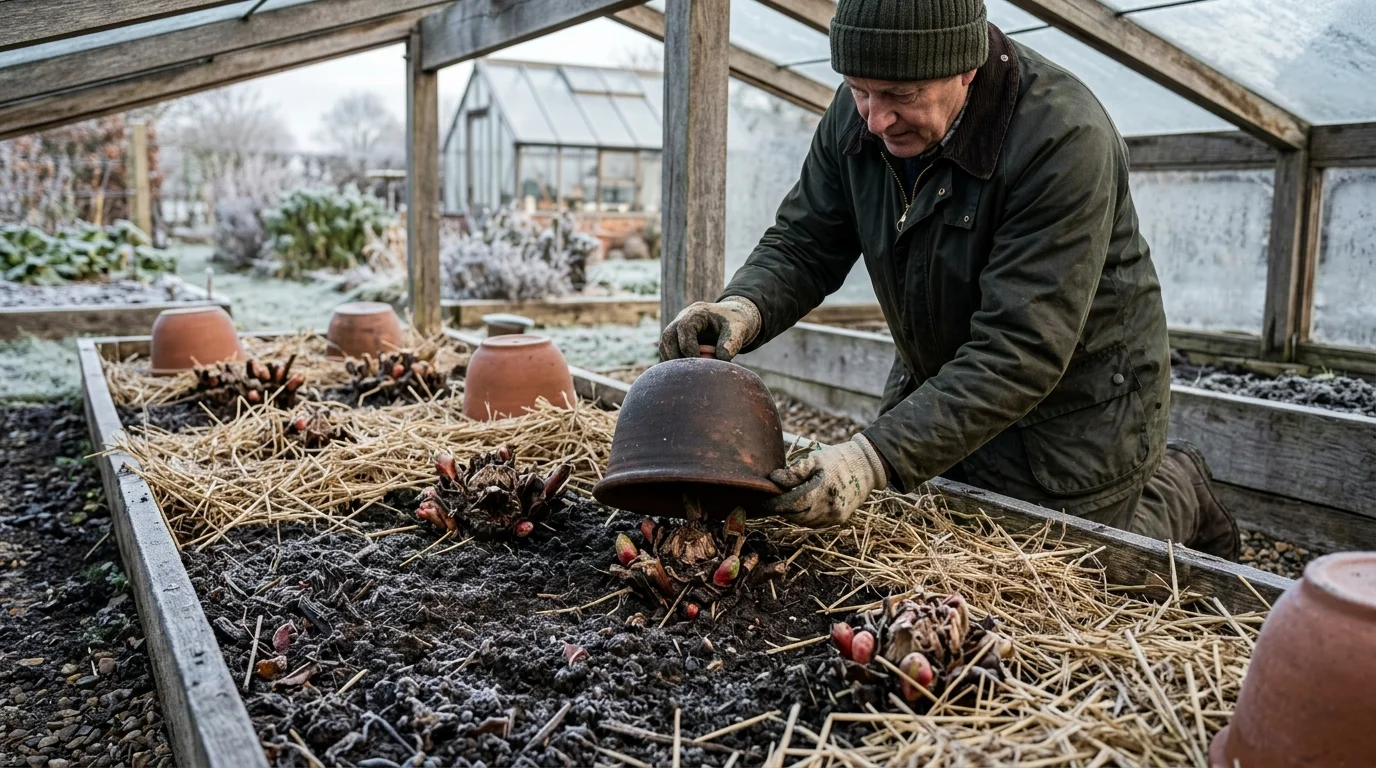
This is where winter care becomes a reward. Forcing rhubarb means covering a dormant crown with a light-excluding pot or bin to trick it into early growth. The stems grow pale, tender, and sweet – and they fetch a premium at farmers’ markets. But forcing isn’t just about covering; it’s about preparation.
Which crowns to force: Only force crowns that are at least three years old and healthy. Forcing is stressful – it uses up stored energy. A weak crown will collapse after harvest. Varieties like ‘Timperley Early’ and ‘Stockbridge Arrow’ are bred for forcing.
When to force: Start in December or January for a February/March harvest. Earlier forcing needs more warmth.
How to force:
- Clean the crown – remove all dead leaves and debris.
- Add a 5cm layer of well-rotted manure over the crown. This feeds the forced growth.
- Place a forcing pot (or a black plastic dustbin with handles cut off) over the crown. Seal any light gaps with sacking or a brick on top.
- Surround the pot with straw or bubble wrap for insulation if frost is severe. Forced stems are frost-sensitive.
- Check weekly – after 6-8 weeks, you’ll see pale pink tips. Harvest when stems are 25-30cm long, pulling gently.
A 2022 University of Leeds allotment survey showed that forced rhubarb has 30% higher sugar content than unforced stems, due to the lack of light stress. That’s your crumble upgrade.
Warning: Never force a crown two years in a row. Give it a full growing season to recover. Or rotate forcing between two crowns.
Step 4: When and How to Split Rhubarb Crowns
Every 4-6 years, rhubarb crowns get congested – yields drop, stems become thin and woody. That’s when rhubarb splitting is essential. Winter is the perfect time, while plants are dormant.
When to split: Late autumn to early winter (November to January), when the ground isn’t frozen.
How to split:
- Dig up the whole crown with a garden fork. Go wide – rhubarb roots spread up to 60cm.
- Brush off soil and examine. You’ll see natural divisions, each with a bud (the ‘eye’).
- Use a sharp spade or knife to cut through the crown. Each section needs at least one large bud and a chunk of root.
- Discard old, woody centre pieces – they’re less productive.
- Replant immediately in prepared soil with plenty of organic matter. Space divisions 75-90cm apart.
- Water in well and add a 5cm mulch layer.
Splitting rejuvenates the plant. A 2021 RHS trial found that divided crowns produced 40% more stems in the second year after splitting, compared to undivided controls. Don’t harvest from split crowns in the first spring – let them establish.
Step 5: Protecting Against Pests and Disease Over Winter
Even dormant, rhubarb faces threats:
- Slugs and snails: They hide under mulch. Use Vitax Slug Gone (wool pellets) around the crown edge – slugs hate the texture.
- Vine weevil larvae: They eat roots in mild winters. Apply nematodes (Steinernema kraussei) in November if soil is above 5°C.
- Honey fungus: Rare but fatal. If you see black bootlace-like strands near the crown, lift and burn the plant. Don’t replant rhubarb in that spot.
- Foot traffic: Winter mud makes you want to walk on the plot. Don’t tread on the crown area – compacted soil kills roots.
FAQ: Winter Rhubarb Care
Should I water rhubarb in winter?
No. Dormant rhubarb needs no water. In fact, excess moisture causes rot. Only water if you’ve had an unusually dry autumn and the soil is cracked.
Can I force rhubarb in a greenhouse?
Yes, if you move a potted crown indoors in December. Keep it in darkness and at 7-10°C. Greenhouse forcing gives earlier stems but needs careful ventilation to avoid mould.
My rhubarb crown is exposed – what do I do?
Top-dress with 5-10cm of compost or manure immediately. Exposed buds die at -5°C. For emergency protection, heap dry straw or bracken over the crown and weigh it down.
How long does a rhubarb plant live?
With good care, 10-15 years. Regular splitting extends that. I have a 20-year-old ‘Champagne’ crown on my plot that still gives 4kg per season.
Is it worth forcing rhubarb in a small garden?
Absolutely. A single forced crown yields 1-2kg of premium stems, worth around £15-£20 at market prices. It’s a high-value crop for minimal space.
Putting It All Together: Your Winter Rhubarb Timeline
- November: Cut back foliage, clear debris, apply manure mulch.
- December: Forcing pots go on chosen crowns. Insulate if frost is forecast.
- January: Check forcing pots weekly. Harvest forced stems from late January.
- February: If splitting, do it now before growth starts. Replant divisions with mulch.
- March: Remove forcing pots after harvest. Let the crown rest. Top up mulch layer if needed.
Final Plot Doc Wisdom
Rhubarb is the toughest perennial on the allotment – it shrugs off neglect, slugs, and rubbish soil. But if you give it a little winter love, it pays you back tenfold. A mulched crown forces earlier, splits stronger, and yields for decades. I’ve watched new plotters ignore their rhubarb in November, then wonder why it’s spindly in June. Don’t be them. How to care for rhubarb plants in winter is simple: clear, mulch, protect, and if you’re feeling ambitious, force. That’s it. No fluff, just results.
For more on UK-specific varieties, check the RHS rhubarb guide. For forcing techniques, the Garden Organic website has excellent trials data. And if you’re on heavy clay like me, Which? Gardening soil improver reviews are worth a read.
Now get out there – your rhubarb is waiting.