You’ve nurtured your brassicas for months. Then you spot the yellow and black caterpillars. Here’s the real fix.
There’s a special kind of heartbreak reserved for the allotmenteer who lifts a kale leaf to find it skeletonised, with clusters of tiny yellow eggs on the underside. The Cabbage White butterfly – both the Large White (Pieris brassicae) and the Small White (Pieris rapae) – is the single most predictable pest on any brassica bed in the UK. And I say predictable because, unlike blight or clubroot, this one is a sure thing. Every generation of butterfly will find your plants.
I’ve seen new plotters spend hours hand-squishing caterpillars, only to have the next wave arrive the following week. I’ve seen thrifty growers use derris dust (now banned for home use) and wonder why their beneficial insects vanished. And I’ve seen eco-warriors weep over organic-approved sprays that simply weren’t strong enough for an infestation.
Let’s strip away the romanticism. The only truly reliable, low-labour, and pesticide-free method to stop these butterflies ruining your harvest is physical exclusion using ultra-fine netting. But it’s not just about throwing any net over your plants. The devils are in the details – the mesh size, the support structure, and the timing.
Why Your Butterfly Net Might Be Useless (And How to Fix It)
Walk down any allotment site in June, and you’ll see netting draped over brassicas. Some of it is doing nothing. The Large White butterfly is a strong flier and a determined egg-layer. She can squeeze through a 10mm mesh. She can lay eggs right through a wide-weave net if it touches the leaf.
Here is the hard science for UK gardeners. The only mesh size that physically prevents the Cabbage White butterfly from laying eggs is 5mm or smaller. You want a product specifically labelled as ‘vegetable cage netting’ or ‘Butterfly-proof netting’ with a thread count that creates a mesh aperture of 5mm x 5mm maximum. Anything larger is just a fancy sunshade for the caterpillars.
Let’s break down the options:
| Netting Type | Mesh Size | Effectiveness vs. Cabbage White | Best Used For |
|---|---|---|---|
| Standard bird netting | 15-25mm | Useless. Butterflies fly straight through. | Protecting fruit from birds only. |
| Enviromesh (standard) | 7mm x 7mm | Fair. Small Whites may still get through. Large Whites are often blocked. | Carrot fly, leek moth. |
| Ultra-fine insect netting | 5mm x 5mm or smaller | Excellent. Blocks all Cabbage White butterflies. | Brassica protection. |
| Fleece (horticultural) | N/A (fabric) | Excellent (physical barrier) but poor light/air flow. | Frost protection, early season only. |
The takeaway? Spend the extra few quid on 5mm netting. I recommend brands like Vidalia Insect Netting or the specific brassica net from Garland Products. You can find these at most good garden centres or online. Do not buy the cheapest roll from a discount store – check the mesh size on the packet.
Building The Fortress: How to Install Netting That Works
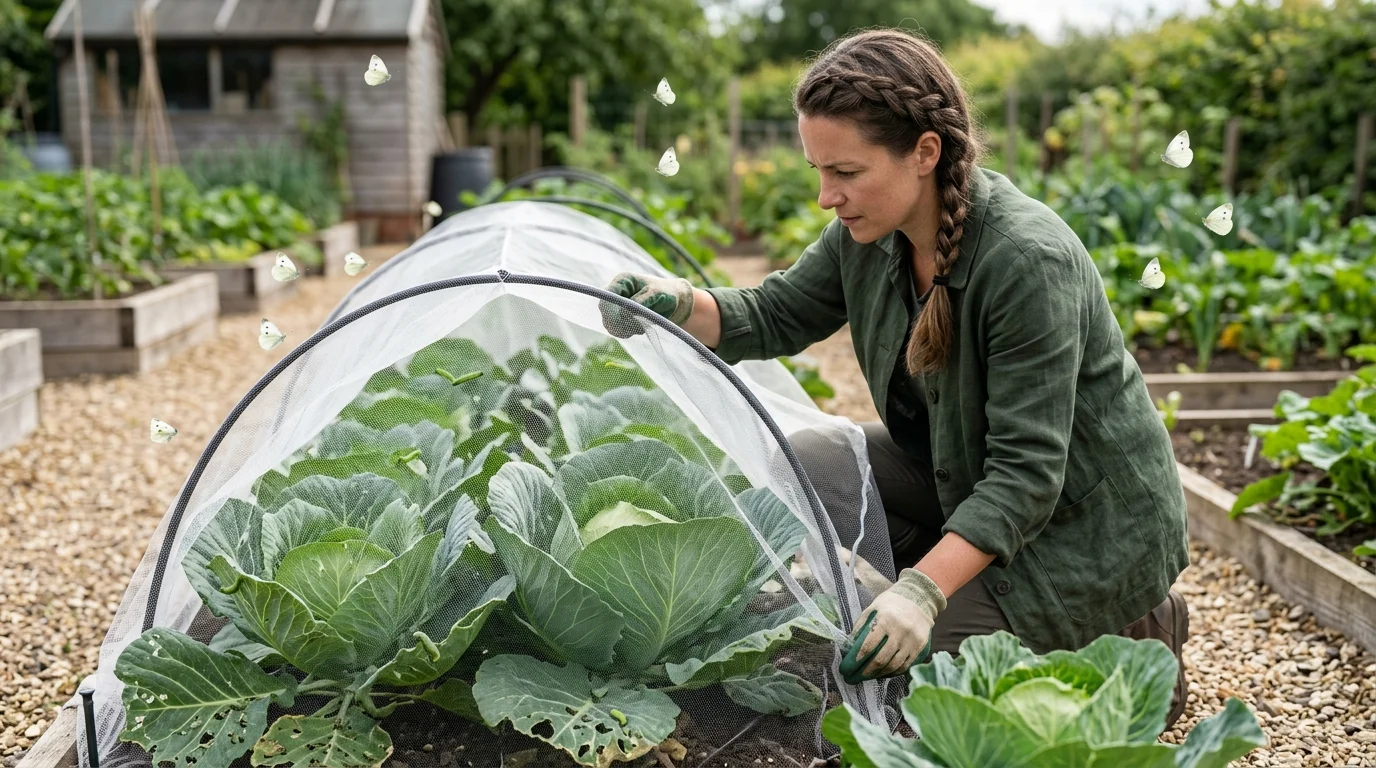
Even the best netting fails if it’s not installed correctly. I’ve seen plotters peg netting directly over a broccoli plant, only to find the leaves pushing against the net, creating a perfect landing pad for a butterfly to lay eggs through the mesh. The rule is: netting must never touch the foliage.
Here is my step-by-step system for a foolproof brassica cage:
- Build a rigid frame first. Use plastic-covered metal hoops (like those from Agriframes) or bamboo canes bent into arches. The frame needs to be at least 30cm higher than your mature crop. For sprouting broccoli, that means a 90cm tall frame.
- Drape the netting loosely. You need slack, not a tight drum. The slack allows the net to billow in the wind without pulling tight against the leaves.
- Bury the edges. This is the step most people skip. Dig a shallow trench around the perimeter of your bed, lay the netting edge in it, and cover with soil. Why? Butterflies are crafty. They will walk under a net that is just pegged down. They will squeeze through the tiniest gap at ground level. Burying the net creates an airtight seal.
- Weigh down with boards or bricks. As a secondary measure, lay heavy paving slabs or long wooden planks on the buried edges. This stops wind from lifting the net and prevents accidental gaps.
- Check weekly. Even with this system, a single butterfly can get trapped inside when you’re hoeing. Inspect the inside of the net every week and remove any butterflies or eggs you find.
When Netting Isn’t Possible: Organic Sprays That Actually Work
I understand that not every plot or every crop can be netted. Perhaps you have a massive patch of kale or you’re using a no-dig system where disturbing the soil for netting is impractical. In these cases, you need a targeted organic spray. But be smart about it.
The most effective organic control for Cabbage White caterpillars in the UK is Bacillus thuringiensis var. kurstaki (Btk). This is a naturally occurring soil bacterium that produces a protein toxic to caterpillars (specifically Lepidoptera) but harmless to humans, bees, birds, and other beneficial insects. It is sold under brand names like Doff Caterpillar Killer and Bioline Caterpillar Killer.
Here is the critical nuance: Btk only works if the caterpillar eats it. It must be applied to the leaves, and the caterpillar must consume it within a few days. It degrades quickly in UV light (sunlight), so:
– Apply in the evening. This gives the spray a night to work before the sun degrades it.
– Reapply after rain. Heavy rain washes it off leaves.
– Target the underside of leaves. That’s where eggs are laid and where young caterpillars feed.
– Accept that it’s not instant. Caterpillars stop feeding within hours but may take 2-3 days to die.
Is Btk a perfect solution? No. It kills all caterpillars, including those of native butterflies like the Small Tortoiseshell or Common Blue, if they wander onto your brassicas. That’s why I always recommend netting as the first line. But for a sudden outbreak on an un-netted crop, Btk is your most effective, least-harmful option.
What about companion planting? I get this question every year. The idea that planting marigolds or nasturtiums near brassicas will repel Cabbage White butterflies is, bluntly, a myth. It’s a lovely idea, and nasturtiums do act as a sacrificial trap crop (they attract the butterflies away from your cabbages), but they do not repel. If you have space for a sacrificial nasturtium patch at the far end of your plot, great. But don’t rely on it as your primary defence. The butterflies will still find your prize Savoy cabbage.
The Eco-Warrior’s Advanced Arsenal: Nematodes and Parasitoids
For those who want to go even more natural than Btk, consider biological controls. The nematode Steinernema feltiae is sold for slug control, but there are specific nematode products for caterpillar control (look for Nemasys Caterpillar Killer). These microscopic worms enter the caterpillar’s body and release bacteria that kill it.
However, nematodes have limitations:
– They need moist soil and cool temperatures (12-20°C) to be active.
– They target caterpillars that are on or near the soil surface.
– They are expensive and have a short shelf life.
For the dedicated eco-warrior, the most fascinating approach is encouraging parasitic wasps (specifically Cotesia glomerata). These tiny, non-stinging wasps lay their eggs inside Cabbage White caterpillars. The eggs hatch and the larvae eat the caterpillar from the inside out. It sounds gruesome, but it’s nature’s perfect check and balance. You can attract these wasps by planting umbellifers like dill, fennel, and cow parsley near your brassicas. It is a long-term strategy, but a deeply satisfying one.
A Quick Summary for Busy Plotters
If you only remember three things from this article, let them be these:
1. 5mm netting is non-negotiable. It is the only physical barrier that works. Bury the edges.
2. Btk spray for emergencies only. Use it at dusk on the underside of leaves. It degrades in sunlight.
3. Don’t trust companion planting as a repellent. Use nasturtiums as a sacrificial crop far from your brassicas.
Frequently Asked Questions (From Real Plotters)
Can I reuse my netting from last year?
Yes, but inspect it carefully. UV damage makes netting brittle. Look for any holes larger than 5mm. A single tear is an open door for a determined butterfly. Patch small holes with netting tape or replace the sheet entirely.
My kale is already infested with caterpillars. Is it too late for netting?
Not at all. First, remove all visible caterpillars and eggs by hand (or blast them off with a hose). Then, install your netting immediately to prevent the next generation. The existing damage is done, but the net will stop the new butterflies from laying more eggs. You can also apply Btk to kill any caterpillars you missed.
Will netting stop other pests like slugs or pigeons?
Pigeons? No. A hungry wood pigeon will land on the netting and peck through it if the foliage is touching. For pigeons, you need a rigid metal cage. For slugs, netting doesn’t help at all – they live in the soil. You’ll need separate slug controls (nematodes, beer traps, or copper tape).
When should I remove the netting?
Remove it when you are ready to harvest. For crops like cabbages and cauliflowers, you can take the netting off once the heads have formed and you are about to cut them. For perpetual crops like kale and sprouting broccoli, keep the netting on all season, but remove it for a few hours when you need to harvest, then replace it immediately.
Final Word From The Plot Doctor
Cabbage White butterflies are not a sign of a bad gardener. They are a sign that you are growing what they love. The key is to stop being reactive and become proactive. Invest in the right netting once, build a proper support system, and you will save yourself hours of frustration. Your brassicas will be spotless, your harvest will be plentiful, and you can spend your precious time dealing with the other 99 problems that allotment life throws at you.
Grow smarter, not harder.