You’ve Got the Keys – Now Don’t Touch a Spade
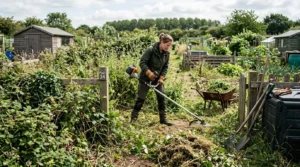
Let’s be brutally honest: the single biggest mistake I see on new plots isn’t couch grass, bindweed, or even rubbish. It’s enthusiasm. You get the keys, your brain floods with images of prize-winning pumpkins and perfect carrots, and within an hour you’re hacking at brambles with a rusty fork. Stop. Right now.
I’ve seen more new plotters burn out in their first fortnight than I care to count. The secret to a thriving allotment isn’t speed – it’s strategic observation. Your first week is not about planting. It’s about gathering intelligence. Here is your no-nonsense, science-backed checklist for what to do first when you get an allotment.
Week One: The Intelligence Phase (Days 1-3)
Before you clear a single weed, you need answers to three questions. Your entire growing season depends on it.
1. What’s hiding in the soil?
Walk every square metre of your plot. Don’t just look at the surface – scrape the top layer back with your boot or a trowel. I’m looking for the big three: bindweed (those white, brittle roots that snap like chalk), couch grass (creeping, pointed rhizomes), and ground elder (leaves that smell like stale parsley when crushed).
These perennial thugs need a different strategy than annual weeds. If you rotavate a bindweed patch, congratulations – you’ve just turned one plant into fifty. Make a simple map of your plot. Sketch where the worst patches are. You’ll deal with them later, but you need the intel now.
2. What’s the light doing?
Spend a full day noting where the sun hits. The UK’s low-angled summer sun means shade patterns shift dramatically. I use a simple method: at 9am, 12pm, and 3pm, stand at each corner of your plot and see what’s casting shade. Is it a neighbour’s shed? A hawthorn hedge? Your own future bean poles?
This determines your zone plan. The sunniest spot (6+ hours direct sun) is for tomatoes, peppers, and sweetcorn. The shadier spots are for brassicas, salads, and rhubarb. Don’t guess – measure.
3. What’s the pH?
You can’t see soil pH, but your plants will scream at you if it’s wrong. A pH of 6.5-7.0 is the sweet spot for most veg. Too acidic (below 6.0) and brassicas get clubroot. Too alkaline (above 7.5) and potatoes get scab.
Buy a cheap soil test kit – the RHS recommends simple colour-change kits from any garden centre. Test three separate areas of your plot. If you’re on clay (like most of us in Yorkshire), you’re likely looking at pH 6.2-6.8. Write the results down. This is your baseline.
| Symptom | Likely Issue | First Action |
|---|---|---|
| Water pools on surface for hours after rain | Compacted clay or silt | Do not dig wet soil – wait. Test drainage with a 30cm hole filled with water; if it takes >6 hours to drain, plan for raised beds. |
| Thick, white, brittle roots everywhere | Bindweed infestation | No-dig / sheet mulching with cardboard and 15cm of compost. Digging spreads it. |
| Soil smells like damp basement (sour) | Waterlogged and anaerobic | Prioritise drainage – add grit and organic matter, but only when soil is dry enough to crumble. |
| Surface is rock-hard when dry | Severe compaction | Broadfork or use a garden fork to aerate – do NOT rotavate. You’ll create a concrete pan. |
Week One: The Clearance Strategy (Days 4-7)
Now you have your map, your light data, and your pH results. It’s time to clear – but strategically.
Rubbish: The Three-Bin System
Grab three separate piles or builders’ bags. Label them:
- Burn pile: Woody stuff (brambles, thick roots, diseased prunings). Do not compost these – bindweed roots can survive a cool compost heap.
- Council tip pile: Carpet, plastic sheeting, glass, metal. This is not your problem to solve – the council gave you this plot, they can take the hazardous waste.
- Compost pile: Annual weeds (without seeds), soft green material, kitchen scraps from your home. This is your gold.
Do not skip the burn pile. A small bonfire (check your site rules first – many allotments restrict fires) is the best tool for destroying perennial weed roots. I burn mine in an old metal dustbin with holes drilled in the bottom. Ash is then bagged and stored dry – it’s a brilliant potassium source for your fruit bushes later.
Weed Strategy: Pick Your Battle
Based on your map, choose one of three approaches for each section:
- Sheet mulching (for bindweed/couch grass): Lay thick cardboard (remove tape and labels), overlap edges by 30cm, wet it thoroughly, then pile on 15-20cm of well-rotted manure or mushroom compost. This starves the roots of light. It takes 6-9 months, but it works on clay.
- Hand-digging (for annual weeds like chickweed): Fork the area over, remove every root fragment, and rake level. This is fine for small patches (under 10m²).
- Leave it (for areas you won’t plant this year): If your plot is massive (say 250m²), you do not need to clear it all. Mark out 30m² for this season. Cover the rest with black weed membrane (woven, not plastic sheeting) and weigh it down. You’ll tackle it next year.
The Science of ‘Stop and Wait’
Here’s where most new plotters break. They’ve cleared two square metres, the sun is shining, and they want to plant something. Anything. So they stick in a tray of leeks or some broad beans.
Don’t.
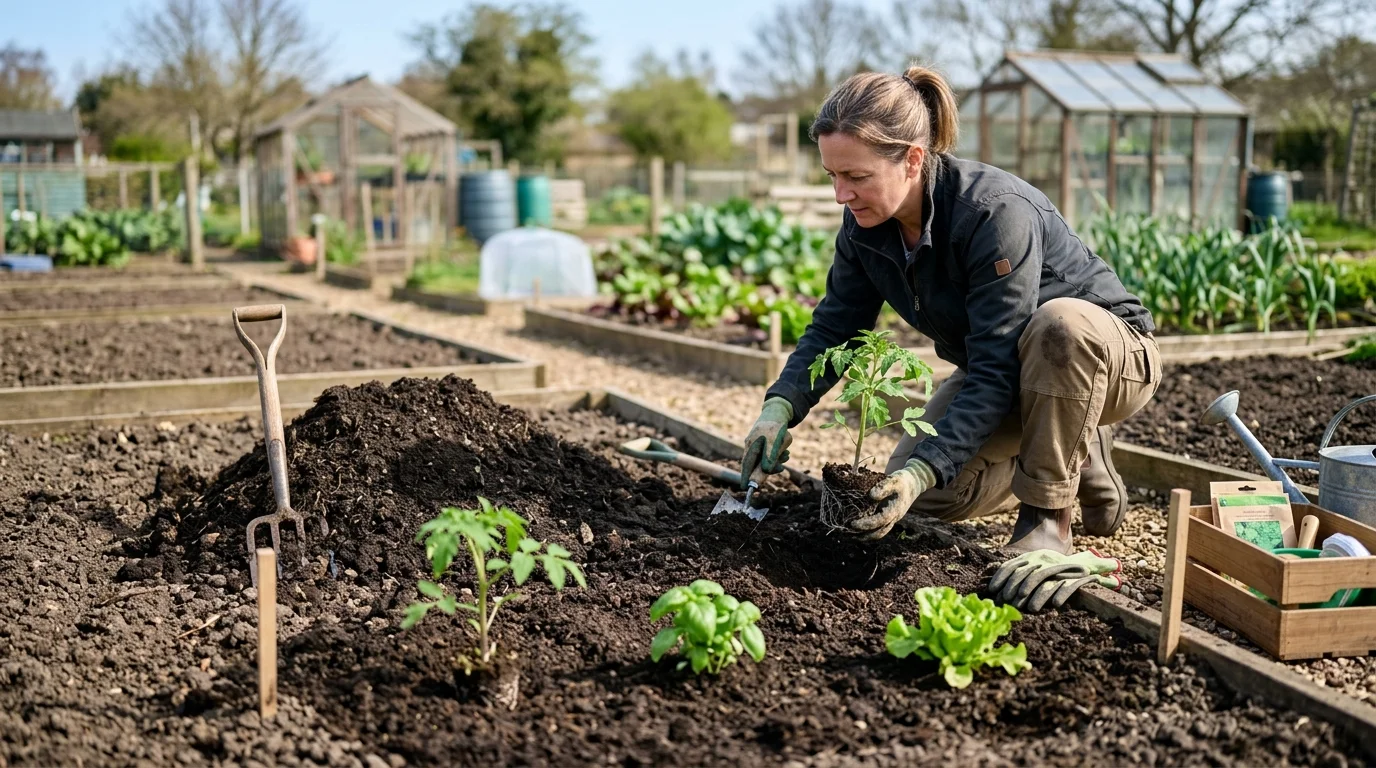
Your soil needs time to settle after any digging or sheet mulching. If you’ve turned clay, the structure is temporarily damaged. Rain will compact it. Worms need weeks to rebuild their tunnels. Plant into unsettled soil, and you’ll get stunted roots and heartbreak.
Instead, spend the rest of your first week doing this:
- Order your compost delivery: For a 30m² growing area on clay, you need at least 1 cubic metre of organic matter (well-rotted manure or green waste compost). Book it for week three.
- Test your water source: Fill a watering can from the site tap. Does it smell of chlorine? Is the pressure low? If it’s a rain butt, is it clean? You don’t want to discover a broken tap in July.
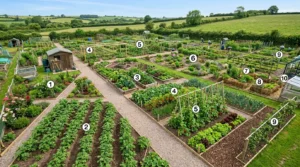
- Build your path layout: Use your light data to plan beds. Standard beds are 1.2m wide (you can reach the middle from both sides) with 45cm paths. Mark them with string and canes. Walk the paths for a week – adjust if they feel too narrow.
- Make a realistic planting plan: Use the RHS’s online sowing calendar (they have one specific to your region). Note that in the UK, your first sowing window for most crops is mid-March to early April. If you’ve got a plot in February, you have time. Use it.
Your First Week Checklist (Print This)
- Walk plot, map weed hotspots and light levels.
- Test soil pH in three areas.
- Clear rubbish into three piles (burn / tip / compost).
- Choose your weed strategy per zone (sheet mulch / hand-dig / leave).
- Do NOT rotavate or dig wet clay.
- Order compost for week three.
- Test water supply.
- Mark out bed and path layout.
- Create a simple sowing calendar for your hardiness zone.
- Read your allotment site rules. Seriously. Some sites ban certain fertilisers or have strict bonfire rules.
When Can You Plant?
The best time to plant is when your soil is workable. Take a handful of soil from 10cm deep. Squeeze it. If it forms a sticky ball that doesn’t crumble when you poke it – it’s too wet. Wait. If it crumbles easily, you’re good to go. On heavy clay in the UK, that’s often not until late March or early April.
Early exceptions: Broad beans, garlic, and onion sets can go in earlier (October-November for overwintering, or February-March for spring planting). But only if your soil isn’t waterlogged. If it’s a bog, wait.
The Slug Reality Check
I can’t write a new plot article without mentioning slugs. Your first year on a new plot, especially on clay, will be a slug bonanza. They love the disturbed soil, the fresh organic matter, and the tender new seedlings you’re desperate to protect.
Your first-week job: Don’t panic. Do order nematodes (the Phasmarhabditis hermaphrodita species) for delivery in early spring. Apply them when soil temperatures reach 5°C. They’re biological control, organic-approved, and work on clay. Pellets are a short-term fix; nematodes are a strategy.
One Final Piece of Advice
Your new plot is not a race. It’s a relationship. The soil doesn’t care if you plant on day one or day thirty. It cares if you treat it with respect. The best thing you can do in your first week is learn – your soil, your light, your weeds, your limits. That knowledge will save you more time, money, and tears than any amount of frantic digging.
For further reading, I strongly recommend RHS Soil Advice and Garden Organic’s no-dig guides. Both are backed by UK-specific research, not Instagram trends.
Now, step away from the spade. Go make a cup of tea, and stare at your plot for another hour. You’re working. I promise.
FAQ: New Plot First Week
Q: Should I rotavate my new plot to break up heavy clay?
A: No. Rotavators on wet clay create a hardpan layer at the bottom of the tines. You’ll turn your soil into concrete. Use a broadfork or hand-dig when the soil is dry enough to crumble.
Q: How do I know if the soil is safe to grow food?
A: If the plot was previously used for growing, it’s likely fine. If it was industrial land, buy a heavy metal test kit (lead, cadmium). Most allotment sites are tested by the council before being allocated.
Q: Can I plant anything in the first month?
A: Garlic and overwintering broad beans (if you have them). Otherwise, wait until soil is workable and temperatures are above 5°C for most crops. Use the time to build compost and plan.
Q: I found a carpet – can I use it as a weed barrier?
A: No. Old carpets leach chemicals and microplastics. Use cardboard or woven weed membrane. Carpet is for the tip pile.
Q: What’s the single most important thing to do in week one?
A: Map your weeds and light. You can’t fix what you don’t measure.