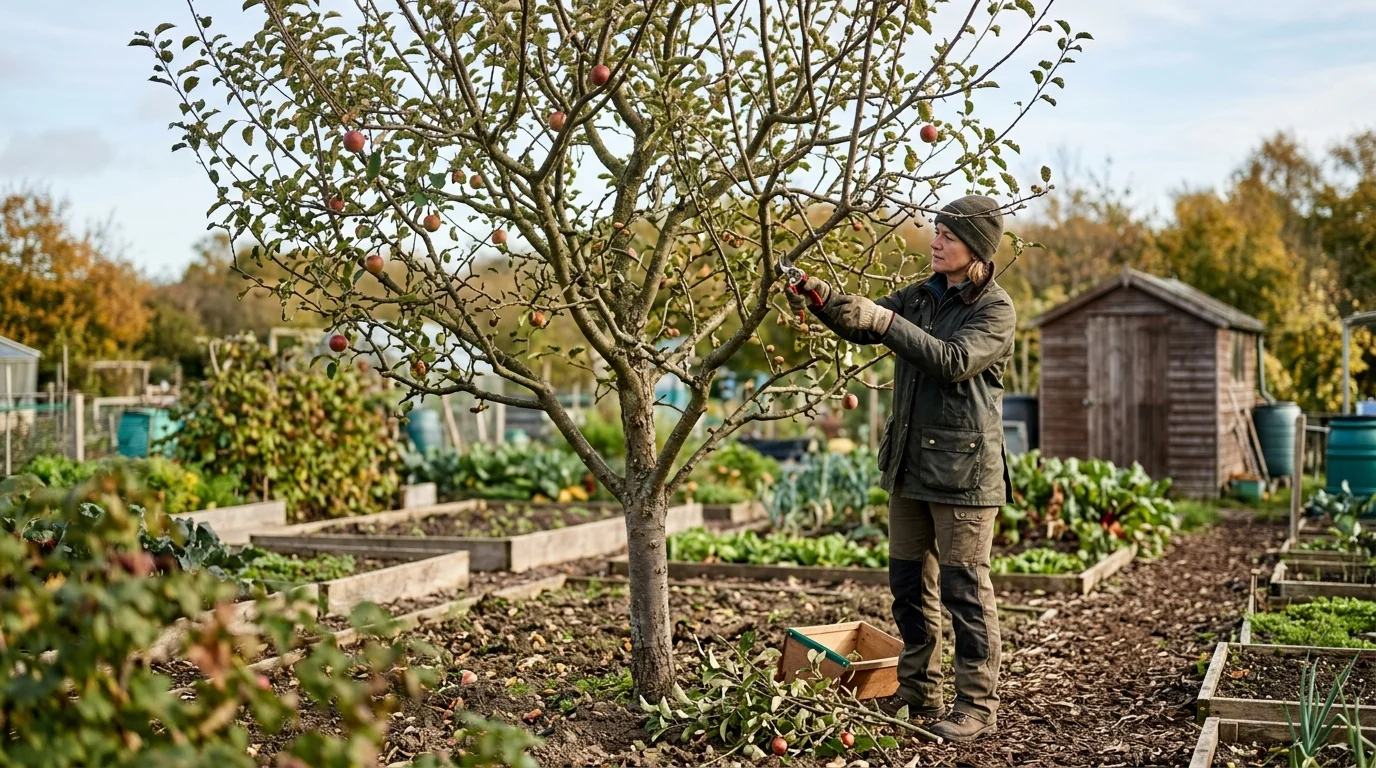
You’ve dug the clay, battled the bindweed, and finally got your apple tree in the ground. Then you stand there, secateurs in hand, staring at a tangle of branches. Do you cut that one? Leave it? The fear of ruining your crop is real. Let’s fix that.
I’ve seen more bungled apple pruning on allotments than slug-riddled lettuces. The classic mistake? Being timid. You snip a twig here, a twig there, and two years later you have a mess of whippy shoots that produce tiny, shaded fruit. Or worse, you go in like a lumberjack, removing half the tree in one go, and end up with a hormonal shock that causes nothing but water shoots. Let’s apply some soil-science logic to tree architecture.
Why prune at all? It’s not about tidiness. It’s about redirecting the tree’s energy. Unpruned, an apple tree prioritises vegetative growth (leaves and wood) over fruit. A well-pruned tree opens up the canopy for light penetration and airflow – critical for ripening fruit and reducing scab and canker. We’re effectively managing a solar panel and a nutrient pump.
The Two Golden Rules of the Allotment Orchard
Before I talk cuts, you need two rules etched into your brain. Break them, and you’re fighting biology.
Rule 1: Prune in the dormant season (leaf fall to bud burst). For the UK, that’s typically late November to late February. Winter pruning invigorates growth. The tree is asleep, so a cut won’t bleed sap, and you can see the branch structure clearly. The exception is summer pruning (late July/August) for stepover apples and trained forms like cordons or espaliers. Summer pruning slows vigour and encourages fruit buds. For a standard allotment bush tree? Stick to winter.
Rule 2: Never remove more than 25% of the canopy in one winter. I know you want to fix that mess fast. But remove too much and the tree panics, sending up a forest of vertical shoots (watershoots) from the trunk. You’ll have no fruit for two seasons as it regrows. Patience. If your tree is a total jungle, spread the renovation over three winters.
Tools of the Trade (Keep Them Clean)
You don’t need a chainsaw. On an allotment, you need:
– Secateurs (bypass, not anvil). For anything up to a pencil-width. Felco No.2 are the gold standard, but any sharp bypass type works.
– Loppers. For branches up to your thumb thickness. Ratchet loppers save your grip strength on older trees.
– Pruning saw. For branches thicker than your wrist. A curved silky saw is my go-to.
– Cleaning spray. A 10% bleach solution or cheap methylated spirits. Dip between cuts if you’re removing diseased wood (canker or fireblight – rare but serious).
Do not use wound paint. The RHS has debunked this. Trees heal better naturally. Wound paint can trap moisture and rot.
Where to Cut: The Three-Cut System
This is where most plotters freeze. Look at a branch. See the slightly swollen ring at the base, where it joins the trunk or a larger branch? That’s the branch collar. Your cut goes just outside this collar, angled slightly away from the bud you want to keep. Never cut flush to the trunk – that leaves a wound the tree can’t seal.
For thick branches (lopper or saw job), use the three-cut method to avoid tearing the bark:
1. Cut a notch on the underside of the branch, a few inches out from the collar.
2. Cut through from the top, a few inches further out. The branch falls cleanly.
3. Now you have a stub. Make your final, precise cut just outside the branch collar.
This prevents the heavy branch ripping a strip of bark down the trunk.
Translating the Jargon: Spurs, Leaders, and Water Shoots
Let’s demystify the terms. An apple tree bears fruit on two types of wood:
– Fruit spurs. Short, stubby, knobbly growths on two-year-old and older wood. These are your gold mines. They produce the flowers and fruit. When pruning, preserve as many spurs as possible. Don’t snip them off thinking they are ugly.
– Tip bearers. Some varieties (like Bramley, Worcester Pearmain) fruit on the tips of long shoots. If you have one, you need a different pruning regime – basically, don’t cut the tips off those shoots. Check your variety. Most modern dessert apples are spur bearers.
What to remove (the ‘Four Ds’):
– Dead, Damaged, Diseased, or Dying. Cut back to healthy wood or the trunk.
– Crossing branches. Where two branches rub together, they create an entry point for disease. Remove the weaker one.
– Vertical water shoots. Those fast-growing, straight-up shoots from the main branches. They fruit poorly and shade the centre. Cut them right out at their base.
– Downward-hanging branches. They get shaded and rarely fruit well. Cut back to an upward-facing bud.
What to keep:
– The central leader (if you have a bush or standard tree).
– Outward-facing laterals (side branches) that are spaced evenly.
– All those knobbly fruit spurs.
Pruning by Tree Form: Bush, Stepover, and Renovation
Your pruning strategy changes based on the tree’s shape. Here’s the cheat sheet.
1. The Standard Bush Tree (Most Common on Allotments)
Goal: An open, goblet shape with a clear centre.
– Year 1-3 (Establishment): You’re building the framework. Select 4-5 well-spaced main branches (the scaffold). Shorten them by about half to an outward-facing bud. Remove the central leader completely to open the centre.
– Established Tree (Year 4+): Focus on spur renewal. Look for older, grey, unproductive spurs. Cut the branch back to a younger, outward-facing lateral. This encourages new spurs. Remove any growth towards the centre.
– Head height rule: Can you walk under the lowest branch? If not, remove lower branches over time. You need airflow at soil level.
2. The Stepover Apple (Space-Saving Genius)
This is the ultimate allotment time-saver. A single horizontal branch, 45cm off the ground. Perfect for a bed edge.
– Formative pruning: You train one main stem to a wire at 45cm, then bend it horizontal. All side shoots get pruned back hard in August (summer pruning) to 3-4 leaves.
– Maintenance: In winter, prune the tip leader back by one-third to a downward bud to keep it contained. In summer, cut all new side shoots on the horizontal branch back to 3 leaves. This forces the tree to create fruit spurs along the whole branch.
– Why it works: The restriction of pruning twice a year makes the tree put energy into fruit, not wood. Perfect for a dwarf rootstock like M27.
3. The Renovation of a Neglected Tree (The Allotment Rescue)
I see this constantly. A tree that hasn’t been touched in 5 years. It’s a ball of twigs with fruit at the top. Here’s your plan:
– Winter 1: Remove the Four Ds. Remove one or two large, crossing limbs. Thin out water shoots. Stop. Do not do more.
– Summer 1: Any vigorous vertical shoots that appear? Remove them.
– Winter 2: Shorten remaining main branches by a third to an outward bud. Thin out the worst of the crowded spurs.
– Winter 3: Now you have a manageable shape. Treat it as an established tree.
You will lose a season of fruit during renovation. Accept it. You are building a long-term productive machine.
Visual Reference: A Pruning Decision Table
Use this when you’re stood on the plot with wind in your face.
| Branch Type | What to Do | Why |
|---|---|---|
| Thin, whippy shoot (less than pencil width) | Cut back by half to an outward-facing bud. | Encourages it to thicken and form spurs. |
| Fat, vertical watershoot | Remove completely at base. | Steals energy, fruits poorly. |
| Old, grey, gnarled spur | Cut the branch just above a younger, green lateral. | Renewal – young spurs fruit better. |
| Branch growing into centre | Cut back to an outward-facing bud or remove. | Opens canopy for light and air. |
| Stepover side shoot (summer) | Cut back to 3 leaves from the horizontal branch. | Creates fruit spurs for next year. |
| Diseased branch (canker, scab) | Cut 15cm below visible damage. Sterilise tools. | Prevents spread. Burn the removed wood. |
Common Mistakes (And How to Avoid Them)
– Pruning in autumn. Leaves are still on? Wait until December. Autumn pruning can stimulate new growth that gets killed by frost.
– Leaving stubs. A long stub dies back and rots, inviting disease. Cut close to the collar.
– Pruning too high. You can’t reach the centre of the tree? Then you shouldn’t have let it grow that tall. Reduce height gradually.
– Ignoring the rootstock. A tree on dwarfing rootstock (M9, M27) needs less pruning than a vigorous one (MM106). Heavy pruning on a dwarf can kill it.
Aftercare: What Your Tree Needs Post-Trim
A prune is a stress event. Help your tree recover:
– Mulch. After pruning, apply a 5cm layer of well-rotted manure or garden compost around the root zone (not touching the trunk). This feeds the soil biology that supports the roots.
– Don’t fertilise now. Wait until spring (March). High nitrogen now encourages soft growth that gets frost damage.
– Check for biennial bearing. If you pruned hard, the tree might try to fruit massively next year, then nothing the year after. Thin the fruit in June (remove every other apple) to prevent this.
Your Month-by-Month Winter Pruning Timeline
- November: Stop. Leaves are dropping. Wait until they are fully off.
- December: Prime time for bush trees. Start your Four Ds removal.
- January: Best month for major cuts. The tree is fully dormant.
- February: Finish pruning before buds break. Watch for early-flowering varieties.
- March: Put away saws. If you haven’t pruned, leave it until next winter.
When Not to Listen to the Internet
You’ll read advice about ‘pruning to an outward-facing bud is always correct’. It’s a good rule, but not a law. On a strongly weeping variety, you might prune to an upward bud to raise the branch. On a stepover, you prune to a downward bud to keep it low. Use guidelines, but look at your tree. Your tree tells you what it needs.
Final Word: Grow Smarter, Not Harder
Pruning an apple tree isn’t a mysterious art. It’s a simple set of biological rules. Remove the dead and crossing stuff, open the centre, preserve the spurs, and respect the 25% rule. Do that, and your allotment tree will reward you with buckets of fruit for years. And next time you’re stood there with secateurs, you won’t freeze. You’ll see the tree for what it is: a solar-powered fruit factory that just needs a little direction.
FAQ: Quick Answers on Allotment Apple Pruning
Q: Can I prune my apple tree in summer?
A: Yes, but only for trained forms like stepovers, cordons, and espaliers. Summer pruning restricts growth and speeds up fruit spur development. For standard bush trees, stick to winter.
Q: Help! I cut off all the spurs. Will it fruit?
A: Likely not this year, but don’t panic. The tree will regrow new spurs over the next 12-18 months. Feed it with a mulch and let it recover. Next winter, leave it alone.
Q: What do I do with the pruned branches?
A: Never put diseased wood in the compost. Burn it or take it to the tip. Healthy wood can be chipped for paths or used as pea sticks. Thick branches can be dried and used as firewood.
Q: My tree is on an allotment with heavy clay. Does that change pruning?
A: Yes. Clay holds water, which can cause root rot. Prune to keep the centre very open for airflow. Also, avoid pruning too late in spring as wet clay can lead to silver leaf disease infection.