You’ve Finally Got That Small Plot—But Can You Really Grow Fruit Trees?
You’ve carved out a 10×5 metre patch on your new allotment. You’ve battled the bindweed, dug in well-rotted manure, and now you dream of picking your own apples or plums. But every gardening book tells you that fruit trees need ‘standard’ rootstocks that grow 8 metres tall. That’s enough to make any small-plotter feel defeated before they start.
Let’s kill that myth right now. You absolutely can grow fantastic fruit on a small allotment—you just need to choose the right dwarf rootstock and training system. I’ve been running trials on our Yorkshire clay for 15 years, and I’ve seen plotters squeeze 30kg of apples from a single espalier trained against a shed wall. The secret isn’t magic; it’s science. Specifically, it’s understanding how rootstocks like M26 for apples and Pixy for plums control tree vigour, and how you can bend that science to your will.
The core principle is simple: you control the roots, you control the tree. With a dwarfing rootstock, you limit the top growth so the tree focuses its energy on fruiting, not towering skyward. Let’s dig into the real-world options that work on a British allotment.
Rootstock 101: The ‘Underground Engine’ You Need to Know
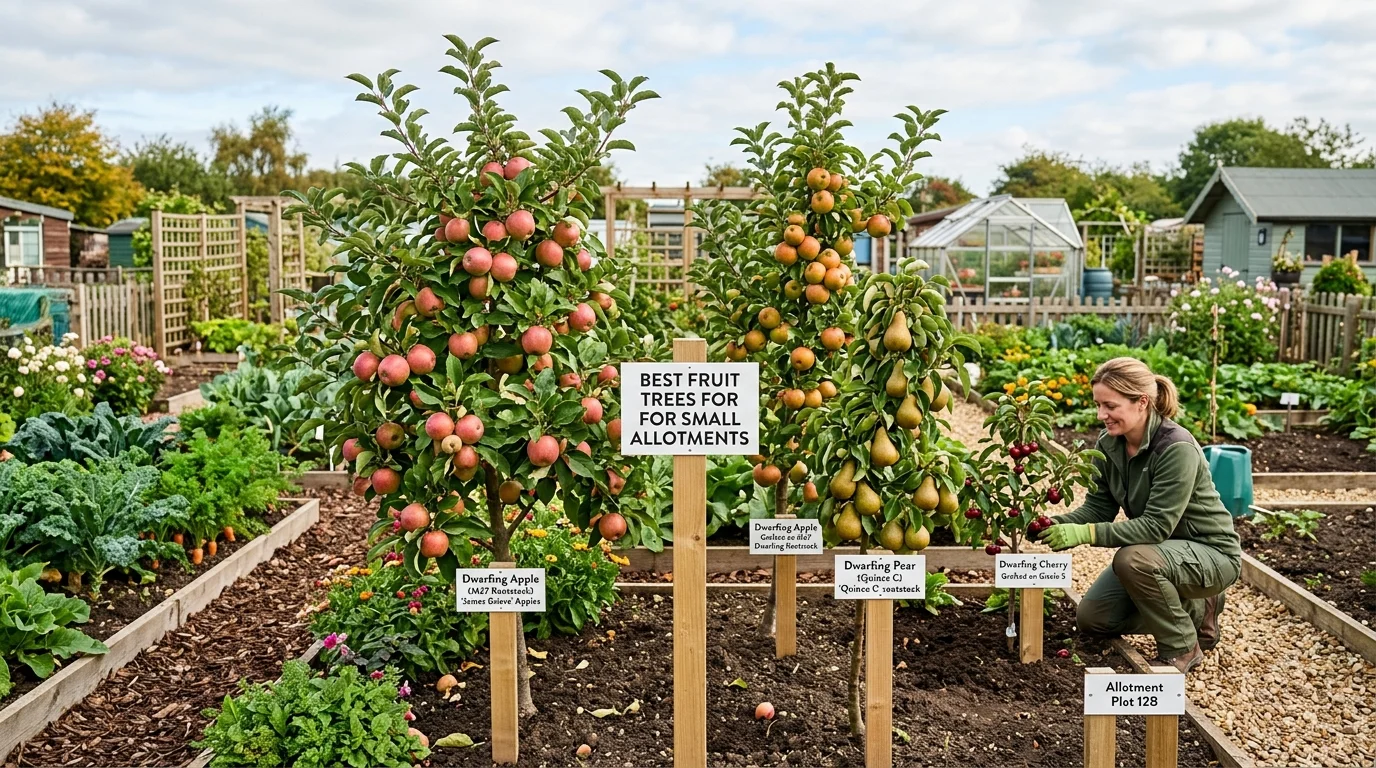
Every fruit tree is two plants grafted together. The top (the scion) is your chosen variety—say a ‘Bramley’ apple. The bottom (the rootstock) determines the tree’s final size, how quickly it fruits, and its anchorage. For small plots, you want rootstocks that are ‘very dwarfing’ to ‘dwarfing’. Here are the star players for UK conditions:
| Fruit Type | Recommended Rootstock | Mature Height (approx.) | Spacing (min.) | Best for… |
|---|---|---|---|---|
| Apple | M27 (very dwarfing) | 1.5-2m | 1.5m | Container growing, stepovers, micro-espaliers |
| Apple | M26 (dwarfing) | 2.5-3.5m | 2.5m | Open-centre bushes, cordons, espaliers on good soil |
| Pear | Quince C (dwarfing) | 2.5-3m | 2.5m | Cordons, espaliers; needs good drainage |
| Plum / Gage | Pixy (dwarfing) | 2.5-3m | 2.5m | Bush trees, fan-trained against walls |
| Cherry (sweet) | Gisela 5 (dwarfing) | 2.5-3m | 2.5m | Fan or bush; requires netting against birds |
A critical note on M27: It’s incredibly dwarfing, but it needs perfect soil—free-draining, fertile, and staked permanently. On heavy clay, it can struggle. I’d only recommend M27 if you’re growing in a large container or very raised bed. For most allotment clay, M26 is your reliable workhorse.
Training Systems: How to Squeeze More Fruit into Less Space
Once you’ve chosen your rootstock, the next decision is how you train the tree. This isn’t about aesthetics—it’s about maximising light interception and your harvest per square metre. Here are the three systems that work on tight plots:
- Espalier (horizontal tiers): Perfect for a south- or west-facing fence. You train branches horizontally along wires. This creates a ‘fruit wall’ that’s only 30-45cm deep. One apple on M26 can produce 8-10kg per year in a space 2m wide x 2m tall. Pro tip: Use a ‘family tree’ (two compatible varieties grafted onto one rootstock) for cross-pollination in a single tree.
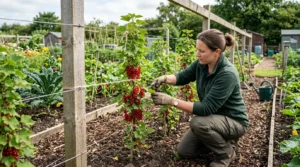
- Cordon (single stem): The ultimate space-saver. You grow the tree as a single, angled trunk (at 45 degrees) with short fruiting spurs. Plant them 60-90cm apart along a row. Four cordons can replace one bush tree and give you four different apple varieties. Blight-resistant cordons are a game-changer on allotments where disease pressure is high.
- Stepover (low espalier): Essentially a tree trained to just 45cm high. It acts as an edible border for your veg beds. Use M27 rootstock for this. It’s a conversation starter, but yields are modest—around 2-3kg per tree. Great for the ‘Eco-Warrior’ who wants multi-functional edges.
My hard-won advice: Start with a cordon apple on M26 rootstock. It’s forgiving of clay, fruits quickly (year 2-3), and you can plant three varieties in the space of one bed. I’ve helped new plotters go from zero to a full ‘fruit fence’ in two seasons using this method.
Variety Selection: Don’t Plant a ‘Bramley’ Unless You Want a Monster
Even on dwarf rootstocks, the scion variety influences vigour. A ‘Bramley’ on M26 will still grow more strongly than a ‘Discovery’ on M26. For small plots, you want compact, spur-bearing varieties. Here are my three top picks based on RHS and Garden Organic trials:
- Apple ‘Sunset’: A Cox-type dessert apple that’s naturally compact and disease-resistant. Crops heavily in a cordon. Pollinator: ‘Egremont Russet’.
- Plum ‘Opal’: Grows well on Pixy rootstock. It’s self-fertile (no need for a second plum tree) and produces golden-yellow fruits in August. Needs a sheltered spot to avoid frost damage to blossoms.
- Pear ‘Conference’: On Quince C, it stays around 2.5m. It’s partially self-fertile and stores well. Train it as an espalier against a warm wall for best flavour.
Avoid vigorous varieties like ‘Bramley’, ‘Howgate Wonder’ (apple), or ‘Victoria’ plum (on its own) unless you have 4m of space and annual pruning discipline.
The Planting & Aftercare Reality Check
You’ve bought your dwarf tree—now don’t kill it with kindness. On allotment clay, the biggest mistake is planting too deep. The graft union (the knobbly bit on the trunk) must sit 5-10cm above soil level. If you bury it, the scion will root and you lose the dwarfing effect—your tree will rocket up to full size.
Step-by-step planting for success:
- Dig a hole twice the width of the rootball, but only as deep as the roots.
- Mix in well-rotted compost (no fresh manure—it burns roots).
- Insert a sturdy stake on the windward side (southwest in the UK).
- Water in thoroughly and mulch with 5cm of bark or compost—keep it off the trunk.
- Prune back the leader by one-third to encourage branching.
Annual pruning for dwarf trees is non-negotiable. You’re fighting the tree’s natural desire to get big. In winter, prune to maintain your chosen shape—shorten laterals to 3-4 buds on cordons/espaliers. In summer (July/early Aug), pinch back new shoots to let light into the developing fruits.
The Slugs, Birds & Blight Factor
Let’s be honest: small trees attract big problems because they’re often near grass or veg plots. Slugs will climb cordons after rain—wrap a 10cm band of copper tape around the trunk. Birds will strip your cherry or plum buds in spring—invest in VEVOR fruit netting (25mm mesh) and build a frame from bamboo canes.
For apple scab and mildew (rife in damp summers), choose resistant varieties like ‘Red Windsor’ or ‘Fiesta’. If you’re growing pears on Quince C, watch for fire blight—a bacterial disease that causes blackened shoots. Prune out 30cm below infected tissue and sterilise your secateurs with methylated spirits.
FAQ: Your Top 4 Questions on Small-Space Fruit Trees
Q: Can I grow a fruit tree in a container on a patio?
A: Yes, absolutely. Use M27 or M26 for apples, and Pixy for plums. Choose a container at least 45cm wide and deep. Use John Innes No 3 compost, and water daily in summer—containers dry out fast. Feed with a high-potash liquid feed (like Vitax Q4) every two weeks from May to August.
Q: Do I need two trees for pollination?
A: Not always. Many apples are ‘triploid’ (poor pollinators) or self-sterile. Check the variety. For a single tree, choose self-fertile types: ‘Opal’ plum, ‘Conference’ pear, or ‘Stella’ cherry. For apples, you can buy a ‘family tree’ with two compatible varieties grafted onto one rootstock.
Q: My allotment has heavy clay—will dwarf rootstocks rot?
A: M26 and Quince C are tolerant of clay, but they hate waterlogging. Plant on a slight mound (15cm high) to improve drainage. Avoid planting in a low-lying part of the plot. On truly wet sites, consider M9 rootstock for apples—it’s less vigorous but more tolerant of damp.
Q: How long before I get fruit?
A: On M26 or Pixy, expect a few fruits in year 2, and a full crop (3-5kg per cordon) by year 4. Patience pays—don’t let the tree fruit heavily in year 1 or you’ll stunt its structural growth.
Final Word: Grow Smarter, Not Harder
Your small allotment is not a limitation—it’s an opportunity to think differently. By pairing a dwarf rootstock like M26 or Pixy with a space-efficient training system like cordons or espaliers, you can harvest fresh fruit for 5-6 months of the year from a footprint no bigger than a garden bench. The RHS Britain in Bloom judges I’ve worked with consistently reward plotters who maximise yield per square metre—and this is exactly how you do it.
Now stop dreaming about that orchard and start planting your patio fruit fence. You’ll thank me in two summers when you’re picking ‘Sunset’ apples off the fence line while your neighbour struggles with a single, unmanageable Bramley.