Why Your Garlic Needs a Good Frost: The Cold Truth About Clove Splitting
You’ve bought your garlic bulbs, lovingly separated the cloves, and pushed them into the soil. Then winter arrives, and you wonder: Is this freezing weather killing my crop? Let me put your mind at ease. That frost is exactly what your garlic is begging for.
On my clay-heavy Yorkshire plot, I’ve seen beginner plotters panic when January brings a hard freeze. They throw on fleece, they mulch too early, they do everything wrong. The truth is, garlic is a cold-weather warrior. It needs a period of vernalisation – a sustained chill below 10°C – to trigger the physiological process that splits a single clove into a multi-cloved bulb. Without that winter chill, you’ll harvest what we call a ‘round’: a single, solid bulb that hasn’t divided. It’s edible, but it’s a fraction of the yield you were hoping for.
Here’s the science simply put: cold signals the plant to stop focusing on leaf growth and start allocating energy to bulb division. Think of it as the plant’s internal timer. If you’re growing garlic in a mild coastal area like Cornwall, or you plant too late in spring, you skip that timer. The result? A disappointing harvest come July. For a reliable crop on a British plot, you need to plant between late October and early December, ensuring the cloves experience at least 6-8 weeks of soil temperatures below 10°C.
Choosing the Right Variety for Your Plot
Not all garlic is created equal, and this is where many plotters trip up. Supermarket garlic is often grown in warmer climates (China, Spain, Argentina) and may have been treated with growth retardants to stop sprouting. It simply isn’t bred for our cold, wet winters. Stick to certified UK seed garlic from reputable suppliers like Garden Organic or The Garlic Farm on the Isle of Wight.
You have two main camps to choose from:
- Hardneck Garlic (e.g., ‘Chesnok Wight’, ‘Purple Moldovan’): These are the connoisseur’s choice. They produce a flower stem (scape) in late spring, which you must snap off to direct energy back to the bulb. They have fewer, but larger, cloves and a more complex, spicy flavour. They are also generally more winter-hardy. The downside? They store for a shorter period (roughly 4-6 months).
- Softneck Garlic (e.g., ‘Solent Wight’, ‘Lautrec Wight’): These are the supermarket-standard. They don’t produce a scape, have more cloves per bulb, and store for much longer (up to 9 months). They are slightly less hardy in severe winters, so a light mulch of straw or well-rotted compost in December can be beneficial on exposed plots.
For a first-timer on a British plot, I always recommend starting with a hardneck variety like ‘Chesnok Wight’. It’s forgiving on clay, has excellent blight resistance (a common issue in wet UK summers), and the flavour is phenomenal roasted.
Planting Cloves: Depth, Spacing, and Soil Prep
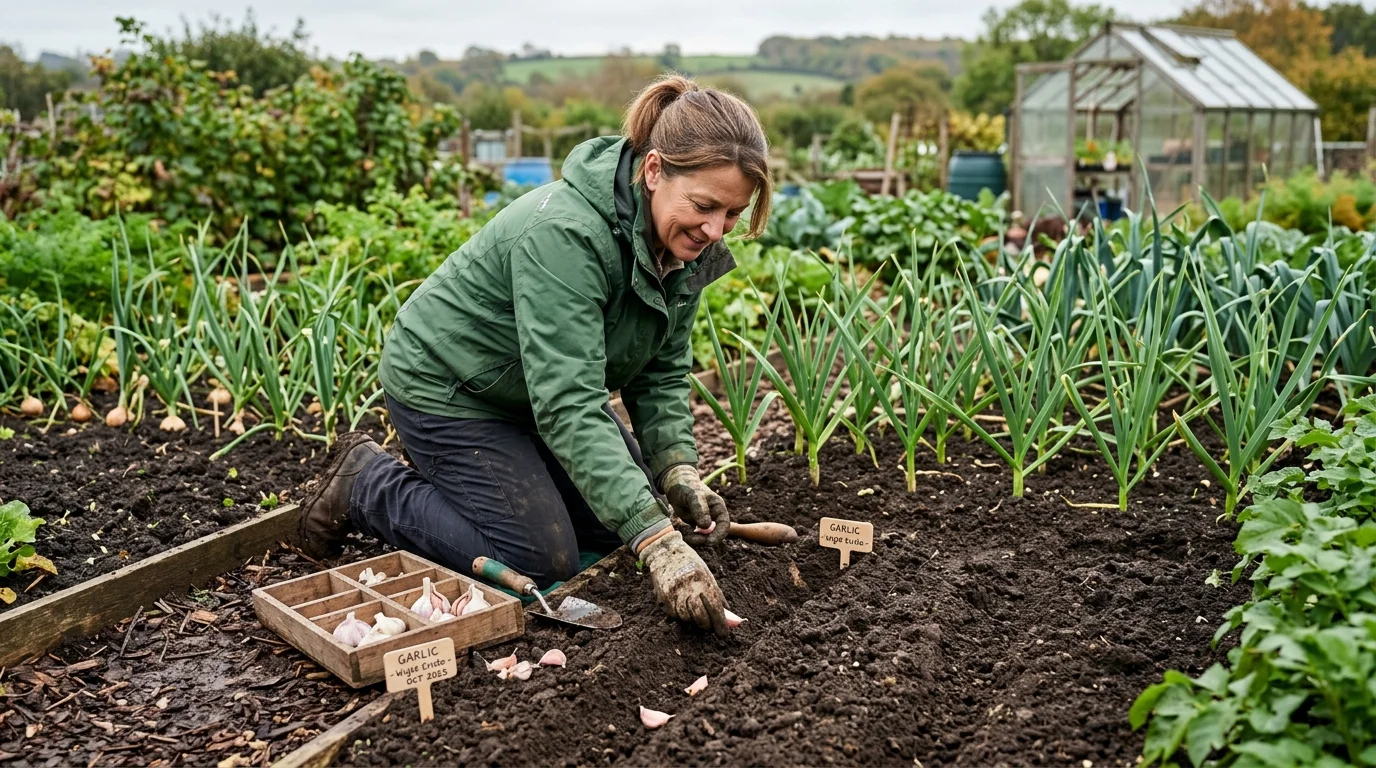
This is the step where most new plotters get the depth wrong. You are not planting a daffodil bulb. Garlic needs to be deep enough to avoid frost heave (being pushed out of the soil by freeze-thaw cycles) but shallow enough to allow the shoot to emerge quickly in spring.
The golden rule on heavy clay: Plant each clove with the pointed tip 5-7cm below the soil surface. On sandy or loamy soil, you can go slightly deeper (7-10cm). Space rows 30cm apart, and cloves 15cm apart within the row. This gives each bulb enough room to fatten up without competing for nutrients.
Soil preparation is non-negotiable. Garlic hates waterlogged roots. If you’re on clay like me, consider a raised bed or a deep-dug trench with added grit. Two weeks before planting, fork in a generous amount of well-rotted farmyard manure or garden compost. Do not use fresh manure – it will burn the tender roots and encourage rot. A balanced general-purpose fertiliser like blood, fish, and bone (at a rate of 100g per square metre) worked into the top 10cm of soil gives the cloves the phosphorus they need for root development.
| Factor | Recommendation | Why It Matters |
|---|---|---|
| Planting Depth (clay soil) | 5-7 cm | Prevents frost heave, allows shoot emergence |
| Row Spacing | 30 cm | Airflow reduces fungal disease risk |
| Clove Spacing | 15 cm | Maximises bulb size per square metre |
| Soil pH | 6.0 – 7.5 | Optimal nutrient uptake |
| Winter Mulch? | Only on exposed sites | Light straw layer protects from severe freeze |
Caring for Garlic Through the Winter Chill
Once planted, your job is mostly to leave it alone. Garlic is not a high-maintenance crop. The cold weather will suppress weed growth naturally, but keep an eye out for the dreaded couch grass or ground elder – their roots will strangle young garlic shoots. A gentle hand-weed in February is all that’s needed.
Watering is a common mistake. Do not water your garlic in winter. The soil is already wet enough from rain. Overwatering leads to basal rot (Fusarium) and white rot (Sclerotium), two fungal diseases that can persist in the soil for years and wipe out your entire allium family (onions, leeks, shallots). If you see yellowing leaves in a wet January, it’s likely root rot – dig one bulb up and check. If the base is mushy and smelly, remove the affected plant and improve drainage.
Come early March, as the soil warms and shoots are clearly visible, give them a feed. A high-nitrogen liquid feed (like diluted comfrey tea or a proprietary seaweed feed) will boost leaf growth. Stop all feeding once the leaves start to yellow in June – that’s the signal the bulb is maturing.
Harvesting Garlic: Timing is Everything
This is where the ‘winter chill’ pays off. A properly vernalised bulb will be fully divided into distinct cloves. You’ll know it’s ready when the lower leaves have turned brown, but the top 4-5 leaves are still green. This usually falls in late June to mid-July for hardneck varieties, and a week or two later for softnecks.
Do not pull garlic by the leaves. Use a fork to gently lift the bulbs from underneath, working carefully to avoid slicing into them. Damaged bulbs won’t store. Shake off the loose soil, but don’t wash them – moisture during curing is your enemy.
Curing is critical for storage. Hang the bulbs (with leaves attached) in a dry, airy, shaded place like a shed, greenhouse, or covered porch. A consistent temperature of 20-25°C with good airflow is ideal. After 3-4 weeks, the leaves will be papery, and the neck will be tight. Trim the roots to 1cm and cut the stem to 2cm above the bulb for softnecks, or leave the stem long for plaiting with hardnecks. Store in a cool, dark, dry place (ideally 5-10°C). A kitchen cupboard is too warm – your bulbs will sprout by October.
Common Pitfalls on the British Plot
- Planting too late: If you plant in February, you skip the cold period. You’ll get a round, not a bulb.
- Fertilising with too much nitrogen in spring: You’ll get massive leaves but tiny bulbs. Switch to a potassium-rich feed (like seaweed) once the leaves are 15cm tall.
- Ignoring rust: Garlic rust (orange pustules on leaves) is common in wet UK summers. It rarely kills the plant, but it reduces bulb size. Remove infected leaves immediately and avoid overhead watering. Plant resistant varieties like ‘Albigensian Wight’.
- Harvesting too late: If the leaves are all brown, the bulb has split open in the soil and is prone to rot. Dig one up as a test.
Frequently Asked Questions About Growing Garlic on a British Plot
Q: Can I grow garlic in a pot on my patio?
A: Yes, but use a deep pot (at least 30cm) and a loam-based compost like John Innes No. 2. The pot will freeze through more than the ground, so insulate it with bubble wrap during hard frosts. Expect smaller bulbs than in open ground.
Q: My garlic leaves have yellow tips. What’s wrong?
A: It’s usually not a problem. Yellow tips in early spring can be wind scorch or a mild nutrient deficiency. If the whole leaf yellows from the base upwards, suspect fusarium rot – improve drainage next year.
Q: How do I save my own seed garlic for next year?
A: Choose the largest, healthiest bulbs from your harvest. Store them as you would eating garlic, but keep them separate. Replant them in October. Do not use garlic from the supermarket – it may carry viruses that reduce yield over time.
Q: Is ‘elephant garlic’ actually garlic?
A: No. It’s a type of leek (Allium ampeloprasum). It grows much larger and has a milder flavour. It needs the same planting conditions but requires more space – 45cm between rows and 25cm between cloves. It is also less hardy in severe winters.
The Bottom Line for a Stellar Harvest
Growing garlic on a British plot is one of the most satisfying tasks you can undertake. It’s a set-and-forget crop that rewards patience. The key takeaway? Embrace the winter chill. Don’t panic about frost. That cold snap in January is your ally, not your enemy. Plant at the right depth, in well-drained soil, with a variety suited to our climate, and you’ll have a harvest that puts supermarket bulbs to shame.
For further reading, the RHS garlic growing guide is an excellent reference, and I’d highly recommend the variety trials conducted by The Garlic Farm for specific UK performance data. Now get your cloves in the ground – that frost isn’t going to wait.