You’ve cleared your plot, dug in some compost, and now you want strawberries. The problem? Birds, slugs, and rot get there before you do.
Let’s be real: strawberries are not a set-and-forget crop. They demand attention. But if you follow a soil-first, science-backed system, you can harvest kilos from a 10-foot row without the heartbreak. I’ve grown them on heavy Yorkshire clay, sandy loam, and even a raised bed on concrete. The principles stay the same.
Choosing the right strawberry type for your allotment
There are three main categories. Ignore the marketing hype. Base your choice on your planting window and how much time you have to pick.
| Type | Harvest period | Best for | Example variety |
|---|---|---|---|
| June-bearing (short-day) | 2-3 weeks in June/July | Freezing, jam, heavy main crop | Honeoye (high blight tolerance) |
| Everbearing (day-neutral) | July to first frosts | Fresh eating over months | Mara des Bois (intense flavour) |
| Alpine (wild) | June to October | Edging paths, small fruit, no runners | Alexandria (sweet, pest-resistant) |
For a standard 10m² allotment bed, I recommend a mix: one row of June-bearing for bulk, and a few everbearing plants for steady picking. Alpine strawberries are lovely but low-yield – treat them as a garnish crop.
Soil prep: the real secret to sweet fruit
Strawberries are shallow-rooted, but they hate wet feet. On UK clay, that means one thing: raised beds or ridges. I’ve lost entire rows to Botrytis (grey mould) because I planted on flat ground after a wet spring.
Dig in well-rotted manure or garden compost six weeks before planting. Do not use fresh manure – it burns roots and introduces weed seeds. Target a pH of 6.0–6.5. Test with a £5 kit from Vitax. If your soil is below 5.5, add lime (100g per sq m) in autumn.
My go-to prep routine:
- Clear all perennial weeds – especially couch grass and bindweed. Use a trowel, not chemicals.
- Rake level, then form ridges 15cm high and 30cm wide.
- Add a base dressing of general-purpose fertiliser (e.g., Growmore at 70g per sq m).
- Cover with woven ground fabric if you’re using the mat system – more on that below.
Planting: timing and depth are everything
Bare-root runners (the most cost-effective option) arrive in spring or autumn. For northern UK plots, plant from mid-March to early May after frost risk passes. Autumn planting works on light, free-draining soils, but on clay I’ve seen 30% winter losses. Stick to spring.
Spacing is non-negotiable: 35cm between plants, 75cm between rows. If you cram them in, airflow drops and grey mould explodes. Use a string line to keep rows straight.
Critical planting rule: the crown must sit exactly at soil level. Too deep, the crown rots. Too high, roots dry out. I tell new plotters: “Bury the roots, not the neck.” Water in well with a liquid seaweed feed (e.g., Maxicrop) to reduce transplant shock.
Straw mulch: why it works and how to do it right
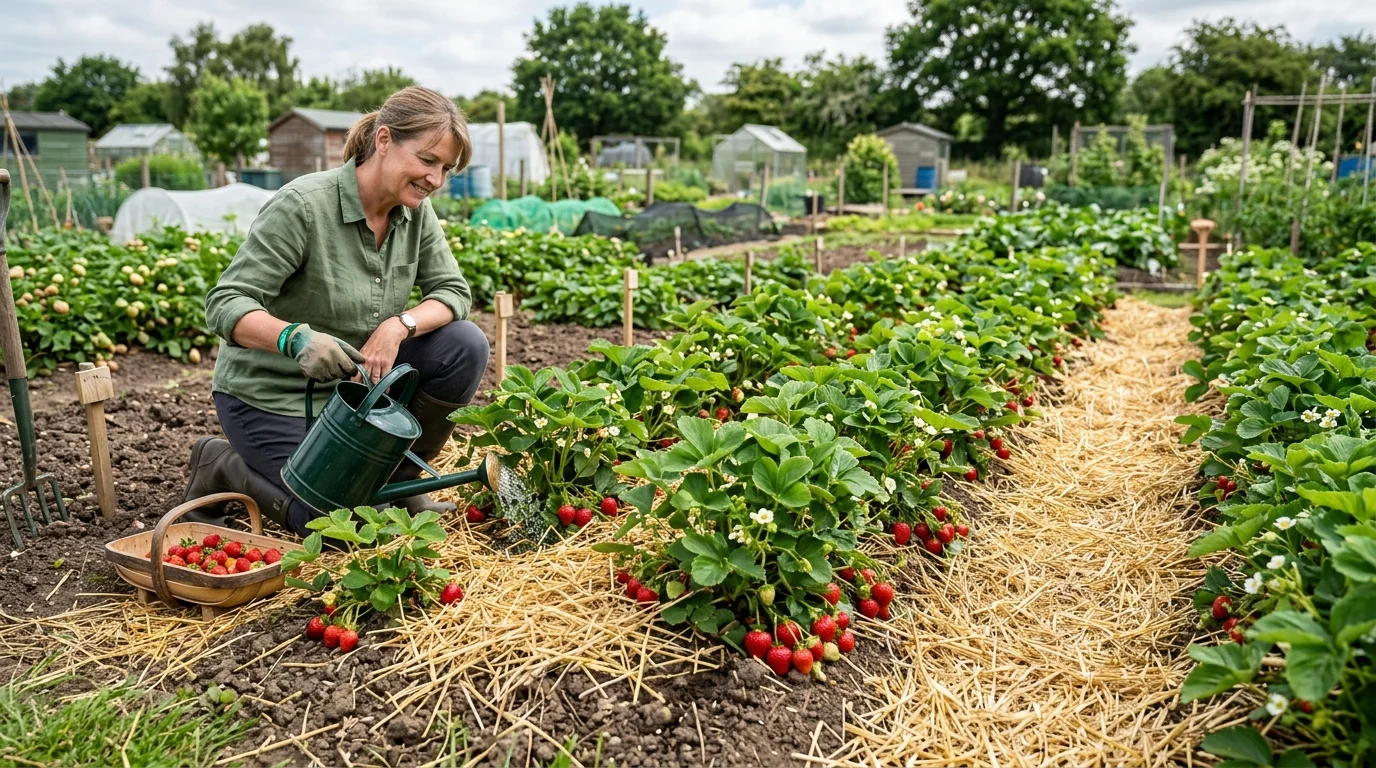
Straw mulch is not optional if you want clean fruit. The RHS trials at Wisley showed a 40% reduction in slug damage and 60% less Botrytis when straw was applied correctly. But here’s the mistake most people make: they lay it too thick, too early.
Apply straw after flowering has started, when the first tiny fruits appear (usually late May in the South, early June in the North). If you apply it before, you trap moisture against the crown and invite rot. Use clean, dust-free barley or wheat straw – not hay, which contains weed seeds.
Lay a layer 5-7cm deep, tucking it under the leaves but keeping it away from the central crown. Replace it after heavy rain if it mats down.
Bird netting: the difference between a harvest and a bird buffet
You will not keep strawberries without netting. Blackbirds and thrushes will take every ripe fruit within 24 hours. But cheap netting kills birds. Use 20mm mesh rigid netting (like the netting sold by Harrod Horticultural) that birds cannot get tangled in.
Build a simple frame: four bamboo canes with plastic pipe connectors, or a fruit cage kit from Agriframes for permanent beds. Drape the netting over the frame, not directly on the plants – birds peck through single-layer netting if it touches the fruit. Peg the edges down with ground staples.
Leave the netting off during flowering to let bees in. Put it on as soon as the first green fruits appear. Yes, you’ll need to lift it to weed – it’s worth the hassle.
Watering and feeding for sweetness
Strawberries are 92% water. During fruit swell (May to July), they need 2.5cm of water per week – roughly a full watering can per sq m. Use a rain gauge or a yoghurt pot to measure.
But here’s the science bit: overwatering during ripening dilutes sugar content. Water deeply once a week, not lightly every day. Use drip irrigation or a rose-end watering can aimed at the soil, not the leaves. Wet foliage is an open invitation to powdery mildew.
Feed with a high-potash liquid feed (like Tomorite or a homemade comfrey tea) every two weeks from first flower until harvest ends. Potassium boosts sugar development and firmness. Nitrogen makes big leaves but bland berries – avoid high-N feeds after flowering.
Strawberry runners: propagating for free plants
Strawberries are natural clones. Each plant sends out runners (long stems with baby plants at the tips). You can let them root into the soil, or peg them into 9cm pots filled with multipurpose compost.
My method:
- Select only the first runner from each mother plant – later ones are weaker.
- Peg the baby plant into a pot of compost using a hairpin or bent wire.
- Cut the runner from the mother plant after 4 weeks, when roots are 3-4cm long.
- Grow on in pots for 6 weeks before planting out in a new bed.
Do not let runners root into the main bed – they crowd the mother plant and reduce fruit size. Remove excess runners weekly through summer. I limit each plant to 5 runners maximum, and only keep 2 for propagation.
Pest and disease management: the evidence-based approach
Slugs: The RHS slug trial at Wisley found that nematodes (Phasmarhabditis hermaphrodita) were 85% effective against keeled slugs when applied in moist soil at 14°C. Apply in May and again in August. Pair with copper tape on raised bed edges.
Grey mould (Botrytis): Caused by poor airflow and wet fruit. Prevent with: wide spacing, straw mulch, and removing any mouldy fruit immediately. Do not compost infected fruit – bag it and bin it.
Powdery mildew: Common in dry summers. Spray with a sulphur-based fungicide (e.g., Vitax Sulphur Plant Fungicide) at first signs – or use a milk spray (1 part skim milk to 9 parts water) every 10 days as a preventer. University of Nottingham research shows milk’s proteins disrupt spore germination.
Vine weevil: Adults notch leaves, but larvae eat roots. Treat with nematodes (Steinernema kraussei) in August when soil is warm.
After harvest: renovation for next year
Once the last fruit is picked (usually late July for June-bearers), do this:
- Cut all leaves down to 5cm above the crown – this removes disease spores and old foliage.
- Remove straw mulch and old netting.
- Feed with a general-purpose fertiliser (30g per sq m) to build next year’s flower buds.
- Water well through August – bud formation happens now.
Replace strawberry beds every three years to avoid soil-borne diseases like Verticillium wilt. I keep a separate propagation bed and rotate my main bed to a different spot in the plot.
Preserving the glut
You will have more fruit than you can eat fresh. Freeze whole berries on a tray first, then bag them – they won’t clump. Make quick jam with equal weights of fruit and jam sugar (add a knob of butter to reduce scum). Or try strawberry vinegar: steep bruised berries in white wine vinegar for 2 weeks, strain, and use in dressings.
Common mistakes to avoid
- Planting in a frost pocket: Strawberries flower early. A late May frost can kill the flowers. Cover with horticultural fleece if frost is forecast.
- Using black plastic mulch: It heats the soil too fast, encourages slug hiding, and doesn’t let rain through. Use straw or woven fabric instead.
- Leaving old leaves on over winter: They harbour red spider mite and mildew. Cut them off in autumn after renovation.
- Not rotating: Strawberries are susceptible to Verticillium wilt, which lives in soil for 15 years. Never plant them where tomatoes, potatoes, or raspberries grew in the last 5 years.
FAQ: Common strawberry questions answered
Q: Can I grow strawberries in a container on my allotment?
Yes, but you must water daily in summer. Use a 30cm pot with drainage holes and multipurpose compost. Replace plants every two years.
Q: Why are my strawberries small and hard?
Likely lack of water during fruit swell, or too much nitrogen. Switch to a high-potash feed and water consistently.
Q: Should I remove first-year flowers for bigger plants?
For June-bearing types, yes – pinch off all flowers in the first year to build strong root systems. For everbearers, let a few fruits form but don’t expect a full crop.
Q: How do I overwinter strawberries?
In exposed plots, cover with a 10cm layer of straw or fleece in December. Remove in February. On clay, ensure drainage is perfect – waterlogged roots kill plants faster than cold.
Final word from the plot
Growing strawberries on an allotment is a battle against weather, wildlife, and disease. But when you bite into a sun-warmed Honeoye picked ten minutes ago, it’s all worth it. Stick to the science: prepare your soil, time your mulch, net early, and propagate smartly. Your sweet summer harvest will repay every hour of work.