Let’s be honest – your first trip to the garden centre is a circus. You’ll see shiny stainless steel, ergonomic handles, and ‘multi-tools’ that promise to peel your potatoes while you weed. Stop. Breathe. Put the novelty fork down.
I’ve watched new plotters waste hundreds of pounds on gear that snaps on Yorkshire clay before the first frost. I’ve also seen thrifty growers nurse a 1970s spade through three decades of couch grass. The difference? The right 10 tools – bought smart, not expensive.
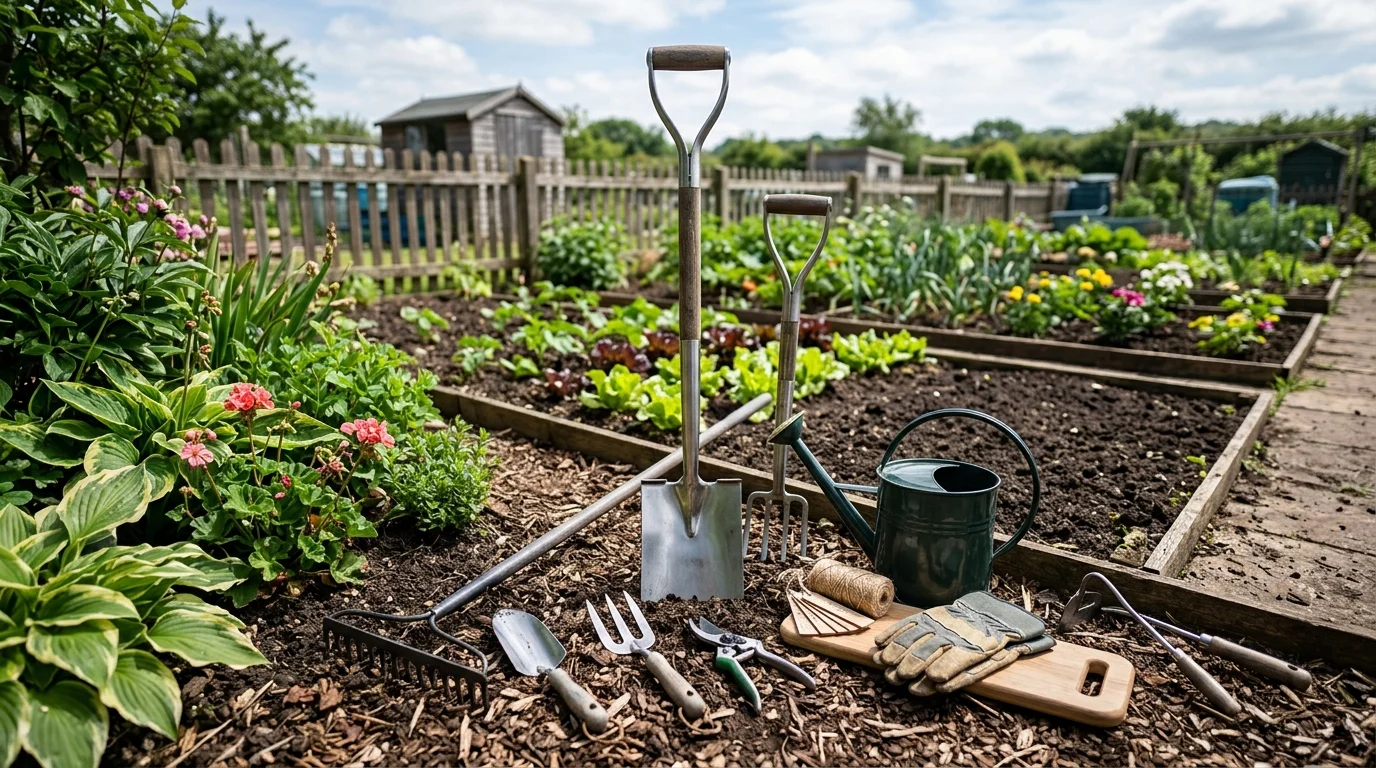
Here is your essential tools for a new allotment list, ranked by how often you’ll use them, how much they matter for soil health, and how to avoid the landfill of junk ‘plot gear’.
Rule one: never buy a tool set in a box. They’re always compromised. Buy each tool individually, from a brand that offers a 10–25-year guarantee. Fork out once, cry once.
1. The Border Spade (Not a Digging Spade)
This is the single most important purchase. A standard digging spade is too wide (200mm+) for most allotment beds and too heavy for a new plotter. You want a border spade – narrower blade (around 175mm), shorter shaft, lighter weight. It’s perfect for edging beds, lifting perennials, and double-digging clay without dislocating your shoulder.
Look for a solid-socketed spade (the handle goes through the metal socket, not a welded tang). Brands like Bulldog, Spear & Jackson, and Wolf-Garten are UK staples. Expect to pay £30–£50. A cheap £10 spade will bend on the first rock.
2. A Stainless Steel Border Fork
Same logic as the spade, but with tines. You need a border fork (narrower head) for breaking up compaction without wrecking soil structure. Stainless steel is non-negotiable on clay – rust flakes off carbon steel and stains your soil, plus it’s weaker.
Use this for: lifting parsnips, aerating beds after rain, and teasing out nettle roots. Never use it as a lever to move stones – that’s what the crowbar is for.
3. The Hori-Hori Knife (Japanese Weeding Knife)
This is the tool you didn’t know you needed. It’s a steel blade with a serrated edge on one side, a smooth edge on the other, and a ruler marked on the blade. It is the ultimate hand trowels replacement.
Use it for: cutting dock roots 15cm deep, transplanting seedlings, dividing perennials, and opening compost bags. The serrated edge saws through rootbound pots. Buy one with a solid wooden handle – the cheap plastic ones snap. Cost: £15–£25. Worth every penny.
4. A Ratchet Secateurs (For Weak Hands and Thick Stems)
Standard bypass secateurs are fine for roses, but allotments grow thick – brambles, raspberry canes, apple suckers. A ratchet mechanism cuts through stems in stages, requiring half the hand strength. This matters if you’re over 50, have arthritis, or plan to prune 50 raspberry canes in one session.
Brands like Felco (model 2 is the gold standard) or easy-cut ratchet models from Burgon & Ball. Never buy anvil secateurs – they crush stems, inviting disease.
5. The Stirrup Hoe (Your Back’s Best Friend)
Forget the Dutch hoe. Forget the draw hoe. On a new plot full of annual weeds, the stirrup hoe (push-pull hoe) is king. It cuts weeds just below the soil surface on both the push and pull stroke, no bending required. You can clear a 30m² bed in 20 minutes.
Look for one with a detachable blade – you’ll replace the blade every season. Wolf-Garten makes a head that fits their multi-change system, or buy a dedicated stirrup from Burgon & Ball.
6. A Soil Thermometer (Not a Luxury)
Your grandmother planted potatoes on Good Friday. That’s folklore, not science. Soil temperature dictates germination. Plant carrots when soil is below 7°C and they rot. Plant beans when above 12°C or they sulk.
A soil thermometer with a 200mm probe costs £8–£12. Stick it in the bed at 10am, check the reading, and only then sow. This single tool saves more seed loss than any pest spray.
7. Long-Handled Potato Planter (The Trowel Killer)
Standard hand trowels are for pots. In allotment soil, you need reach. A long-handled planter (also called a bulb planter) lets you dibble holes for potatoes, leeks, and brassicas standing upright. Your knees will thank you.
Avoid the cheap plastic ones with a sliding mechanism – they jam. Get a stainless steel tube with a foot step. Netherton Foundry do a superb cast-iron version that lasts generations.
8. A Wheelbarrow That Fits Your Plot
Most people buy a 100-litre builder’s barrow. That’s too wide for narrow paths and too heavy when full of wet manure. You need a 75-litre barrow with a pneumatic tyre (not solid – they bounce on uneven ground). A ‘spreader’ tyre (wider, lower pressure) stops it sinking into mud.
If your plot is on a slope, consider a two-wheeled barrow for stability. Yes, they’re more expensive (£80–£120), but they don’t tip sideways when you load compost.
9. A Sharpening Stone (The Forgotten Tool)
You will buy secateurs. You will buy a hoe. You will never sharpen them. A dull blade rips stems, tears roots, and makes you work twice as hard. A medium-grit (1000) diamond sharpening stone costs £10. Use it once a month.
For spades and hoes, a mill file (10-inch, second cut) is better than a stone. Run it along the bevel edge at 45 degrees, five strokes, job done.
10. A Dedicated Slug & Snail Toolkit
I said ‘tools’, not just metal. On a new plot, slug damage in the first year is catastrophic. Your toolkit: a head torch (for night patrols – they’re active at 10pm), a pair of tweezers (for removing slugs rom lettuce hearts), and a bag of Vitax Slug Gone (wool pellets – they don’t work alone, but combined with nematodes, they halve damage).
Do not buy slug pellets containing metaldehyde – it’s banned in the UK for outdoor use. Buy ferric phosphate pellets (brand: SlugClear Ultra) if you must bait.
Tools you DO NOT need (Save your money)
Let me save you from the marketing:
The ‘Hand Trowels’ Set: You don’t need three different sizes. One good stainless steel trowel and the hori-hori knife replace them all.
Kneeler Seat: They get caked in mud, flip over on slopes, and you’ll still kneel. Buy a proper foam kneeler pad (£5 at B&M) instead.
Leaf Blower: On a quarter-plot, a rake does the same job in 10 minutes with zero noise or fuel.
Dibber: A snapped broom handle sharpened to a point works better than any £15 wooden dibber.
Where to spend vs. Where to save
| Tool Category | Spend More (Quality) | Save Money (Cheap is Fine) |
|---|---|---|
| Spade & Fork | Solid-socket, stainless, named brand | Never cheap out – they snap |
| Secateurs | Felco or Burgon & Ball ratchet | Avoid supermarket own-brand |
| Hoe | Stirrup design, replaceable blade | Multi-change handles fine |
| Gloves | Leather palm (Briers Gold) | Cotton/nitrile mix for light weeding |
| Wheelbarrow | Pneumatic tyre, steel frame | Plastic tub is fine, but not B&Q value |
| Hand Tools | Hori-hori knife, long-handled planter | Cheap trowels bend – avoid |
The First-Year Tool Purchase Order
If your budget is tight (under £150), buy in this order:
1. Border spade (£40)
2. Border fork (£35)
3. Hori-hori knife (£18)
4. Stirrup hoe head + handle (£25)
5. Soil thermometer (£10)
6. Ratchet secateurs (£22)
That’s £150 for six tools that do 90% of the work. Add the wheelbarrow, planter, and sharpening stone in year two.
My Personal ‘Plot Gear’ Failure Story
In my first year, I bought a ‘5-piece garden tool set’ from a DIY superstore for £19.99. The spade handle snapped on the third dig. The hand trowel bent into a U-shape pulling a dandelion. The fork tines splayed apart like a fish skeleton.
I took it back. The refund bought half a decent spade. Don’t be me. Buy less, buy better.
External Resources for New Plotters
– RHS Soil Advice Hub – Free guides on testing your soil type before you buy tools.
– Garden Organic – Peer-reviewed research on no-dig and tool-use effects on soil biota.
– Allotment Garden UK – Community forums with tool reviews from real plotters.
FAQ: Common Questions About Essential Tools for a New Allotment
Q: I have heavy clay soil. Should I buy a digging spade instead of a border spade?
A: No. Use a border spade and a strong fork. A full-size digging spade on clay will overload your back. Improve drainage with grit and organic matter over two seasons.
Q: What’s the best brand for hand trowels?
A: Honestly, skip standard trowels. Get a hori-hori knife (brand: Okatsune or Nisaku). If you must have a trowel, buy a stainless steel one from Spear & Jackson with a solid handle – avoid wooden handles that rot.
Q: Can I use kitchen scissors instead of secateurs?
A: On stems thinner than 5mm, yes. On anything thicker, you’ll crush the stem and invite disease. Buy proper ratchet secateurs for cane fruit and brambles.
Q: Do I really need a soil thermometer?
A: If you want to stop wasting seeds, yes. Carrot seeds will not germinate below 7°C – you’re just feeding the slugs. A £10 thermometer pays for itself in one season of saved seed.
Q: How often should I sharpen my spade?
A: Every 4–6 hours of digging. A sharp spade slides through clay; a dull one bounces off. Use a mill file, five strokes per edge, monthly.
Final Word
Your allotment is a marathon, not a sprint. The right essential tools for a new allotment are the ones that survive three seasons of British weather, your own learning curve, and the occasional dropped load of horse manure. Invest in the handle you’ll grip for a decade, not the shiny gimmick that breaks by Bank Holiday Monday.
Now go dig – but sharpen first.