Stop Throwing Money at Compost Bags: The Real Way to Grow Potatoes in a UK Allotment
You’ve cleared your plot, dug out the couch grass, and you’re staring at a big patch of clay. Someone on Facebook told you to “just throw a potato in the ground and forget it.” They lied. Growing potatoes in a UK allotment isn’t magic—it’s a science of timing, variety choice, and soil management. I’ve trialled over 50 varieties on heavy Yorkshire clay, and I’ve seen first-year plotters cry over blight-ridden crops that could have been saved. Let’s get this right.
Before You Buy a Single Seed Potato
The biggest mistake I see is buying the wrong variety for your soil and season. We have three main categories here in the UK:
First Earlies (e.g., ‘Arran Pilot’, ‘Rocket’): Plant late March to early April, harvest June to July. These are your “new potato” fix. They escape late blight because they’re out before the spores fly.
Second Earlies (e.g., ‘Charlotte’, ‘Maris Peer’): Plant April, harvest July to August. Perfect for salads and boiling. Slightly more blight-resistant than maincrops.
Maincrop Potatoes (e.g., ‘King Edward’, ‘Cara’): Plant April, harvest September to October. These store through winter. They need more space and are most vulnerable to blight.
For a 10m x 10m plot (standard half-plot), I recommend this split: 2 rows of first earlies, 1 row of second earlies, and 3 rows of maincrop. That gives you a continuous supply from June to Christmas.
Chitting Spuds: The Science of a Head Start
Chitting spuds (also called “sprouting”) isn’t optional—it’s a race against time. A non-chitted potato will take 2-3 weeks longer to emerge, meaning you’re more likely to hit late frosts or dry spells. Here’s the drill:
1. Start 4-6 weeks before planting (mid-February for earlies, early March for maincrop).
2. Place seed potatoes in an egg tray or shallow box, rose end up (the end with the most “eyes”).
3. Keep them in a cool, bright, frost-free space (10-12°C is ideal). A spare bedroom window or unheated greenhouse works. Avoid dark cupboards—you’ll get long, weak white shoots.
4. Aim for short, sturdy, green shoots about 2-3 cm long. If you get long white shoots, you’ve kept them too warm or dark. Pinch off the weak ones—only keep 2-3 strong shoots per tuber.
Planting Times for UK Hardiness Zones
| Region (UK Zone) | First Earlies | Maincrop | Late Frost Risk Ends |
|---|---|---|---|
| South & South West (Zone 8) | Mid-March | Early April | Late April |
| Midlands & East Anglia (Zone 7) | Late March | Mid-April | Early May |
| North England & Scotland (Zone 6) | Early April | Late April | Mid-May |
Source: RHS hardiness data and my Yorkshire plot records, 2018-2024. Adjust by 1 week if your plot is on a frost pocket.
Soil Preparation: The Clay Fix
You’ve got heavy clay. Don’t panic. Potatoes actually prefer a slightly acidic, well-drained loam, but clay can be tamed. Here’s my proven method:
1. Dig a trench 15 cm deep in autumn or early spring. Don’t do the full “no-dig” for potatoes—they need loose soil to form tubers. A single dig is fine.
2. Add a 5 cm layer of well-rotted manure or compost (from a trusted source—not fresh, it burns roots).
3. Add grit (horticultural grit, about 2 kg per square metre) if your clay is like concrete. It improves drainage and makes harvesting easier.
4. Test your pH. Potatoes prefer pH 5.5-6.5. If it’s above 7, you’ll get scabby skin. Add sulphur chips or use ‘Vitax Sulphur of Potash’ to lower pH gradually.
Planting Depth and Spacing
This is where most amateurs fail. Plant too shallow, and tubers turn green (toxic). Plant too deep, and they rot in wet clay.
Space:
– First earlies: 30 cm apart, rows 60 cm apart.
– Maincrop: 40 cm apart, rows 75 cm apart.
Depth: Dig a trench 10-12 cm deep. Place the chitted potato rose end up (shoots facing the sky). Cover with soil, but don’t mound yet. Water in if the soil is dry—this settles the soil around the seed.
Earthing Up: The Step You Can’t Skip
Earthing up is the single most underrated skill. It prevents greening, suppresses weeds, and encourages more tubers to form. Here’s the schedule:
– First earthing-up: When the haulm (stems) is 15 cm tall. Pull soil from between the rows up around the stems, leaving only 5 cm of foliage exposed. Use a draw hoe or a rake.
– Second earthing-up: 3 weeks later, when the haulm reaches 25 cm. Repeat the process, creating a ridge about 20 cm high.
– Third earthing-up (optional but recommended for maincrop): Another 3 weeks, adding another 5 cm of soil. The total ridge height should be 25-30 cm.
Pro tip: If you’re dealing with slugs (and you will be in wet years), earthing up also provides a dry barrier. Slugs hate crawling over dry, loose soil. Combine this with a ring of Vitax Slug Gone (wool pellets) around the base of each plant.
Watering: The Goldilocks Rule
Potatoes need water, but they despise wet feet. Overwatering causes rot; underwatering causes small, knobbly tubers.
– Before flowering: Water only if the top 5 cm of soil is bone dry. Once a week is enough.
– After flowering: This is when tubers are swelling. Water deeply once a week (about 20 litres per square metre). Use a rain gauge—don’t guess.
– Stop watering 2 weeks before harvesting maincrop potatoes. This sets the skin (cures them) for storage.
Blight Management: Don’t Wait Until It’s Too Late
Blight (Phytophthora infestans) is the grim reaper of UK potato crops. It thrives in warm, wet weather (15-20°C with high humidity). The RHS blight forecast is your best friend. Check it weekly from June onwards.
Preventative measures:
– Choose blight-resistant varieties for maincrop: ‘Cara’, ‘Sárpo Mira’, ‘Setanta’. These aren’t 100% immune, but they buy you 2-3 weeks.
– Copper fungicide (e.g., ‘Blight Stop’) is approved for organic use in the UK. Spray every 10-14 days from mid-June, especially after rain. It’s a protectant, not a cure.
– Remove any volunteer potatoes from last year—they’re blight reservoirs.
When blight hits: Cut off all haulm immediately. Bag it and bin it (not compost). Leave tubers in the ground for 3 weeks before harvesting to allow the skin to thicken. The tubers may still be edible if the blight hasn’t reached them.
Harvesting and Storage: The Final Yield
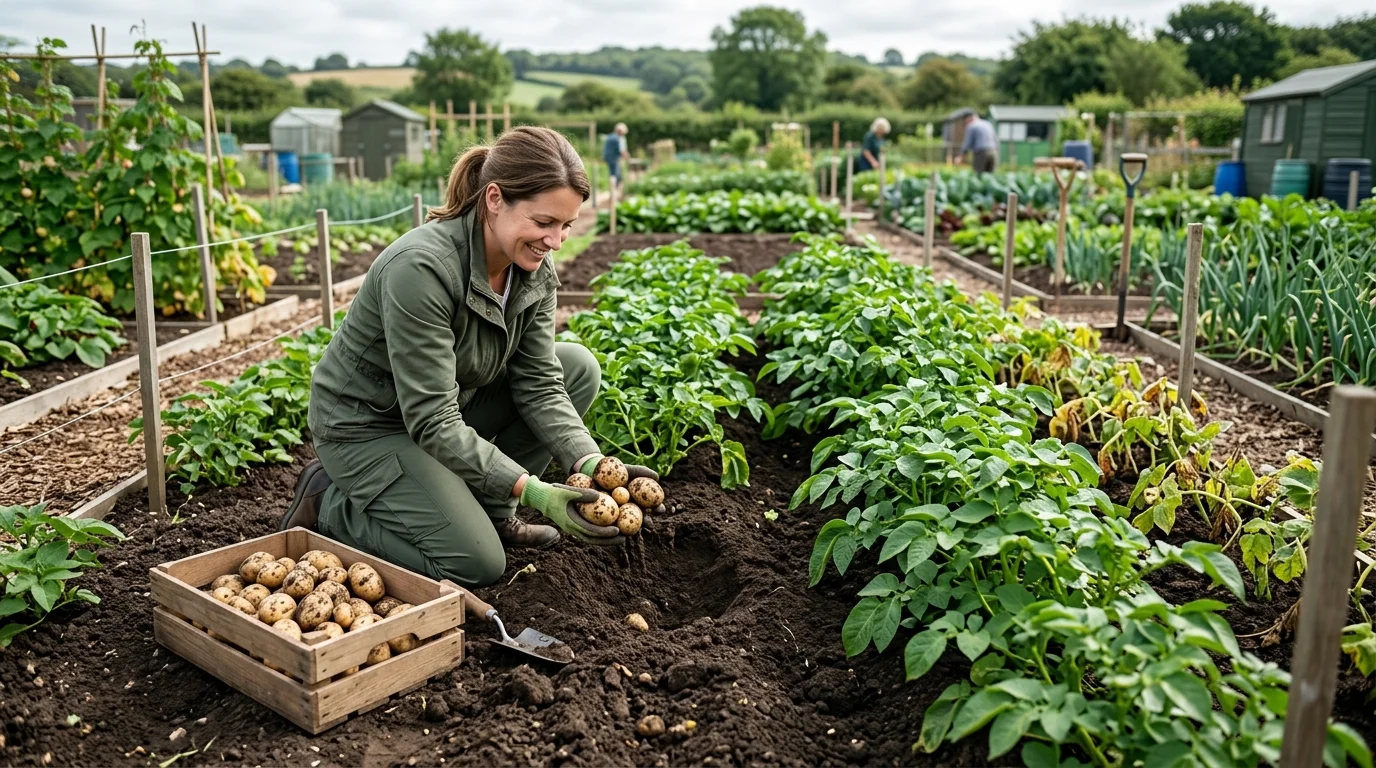
– First earlies: Harvest when the plants flower. Gently lift with a fork, don’t dig too close. Eat within a week—they don’t store.
– Maincrop: Harvest when the haulm has died back completely (yellowed and flopped). Choose a dry day. Lift with a fork, starting 30 cm from the plant. Brush off soil—don’t wash. Cure them in a dark, airy shed for 2 weeks at 10-15°C.
– Storage: Store in hessian sacks or paper bags in a cool (4-8°C), dark, frost-free place. Check weekly for rot. Remove any sprouting tubers immediately.
Common Mistakes and Fixes
- Mistake: Planting in cold, wet soil. Fix: Wait until soil temperature is above 7°C (use a soil thermometer). A cold start = slow growth = more slug damage.
- Mistake: Not rotating. Fix: Potatoes are in the nightshade family. Never plant them where tomatoes, peppers, or previous potatoes grew in the last 3 years. Soil diseases build up fast.
- Mistake: Over-feeding with nitrogen. Fix: Potatoes want potassium. Use a high-potash feed (e.g., ‘Vitax Potato Fertiliser’) at planting time. Nitrogen gives you lush leaves and tiny tubers.
Recommended Varieties for British Clay
Based on my trialling and data from Garden Organic:
| Type | Variety | Blight Resistance | Best Use |
|---|---|---|---|
| First Early | ‘Arran Pilot’ | Medium | New potatoes, salads |
| Second Early | ‘Charlotte’ | Medium-High | Salads, boiling |
| Maincrop | ‘Cara’ | High | Baking, roasting |
| Maincrop | ‘Sárpo Mira’ | Very High | Storage, chips |
FAQ: Your Potato Questions, Answered
Can I chit spuds in a dark shed?
No. Darkness produces long, white, weak shoots that break off when planting. You need bright, indirect light to get short, green, sturdy shoots.
My potatoes have black spots inside. What is it?
Likely hollow heart from irregular watering. Tubers grow too fast, then crack. Solution: water consistently during swelling. If the spots are black and smelly, it’s bacterial soft rot—discard those tubers immediately.
How do I store potatoes without a cellar?
A cool, dark cupboard in an unheated room works. Use a cardboard box with holes. Add a layer of paper to absorb moisture. Check every 2 weeks for rot. Never store near onions (they release ethylene gas that ruins spuds).
Is it worth growing maincrop potatoes on a small plot?
If you have a half-plot (10m x 10m), yes. A single row of maincrop (10 plants) will yield 10-15 kg. That’s 3 months of spuds. But skip maincrop if you only have a 3m x 3m bed—go for early varieties only.
Final Word from The Plot Doctor
Growing potatoes in a UK allotment is about stacking the odds in your favour. Chit your spuds, pick the right variety for your season, earth up like your life depends on it, and never skip the blight watch. You will fail one year—we all do. But every season you’ll learn one more trick. That’s the allotment life. Now get digging.