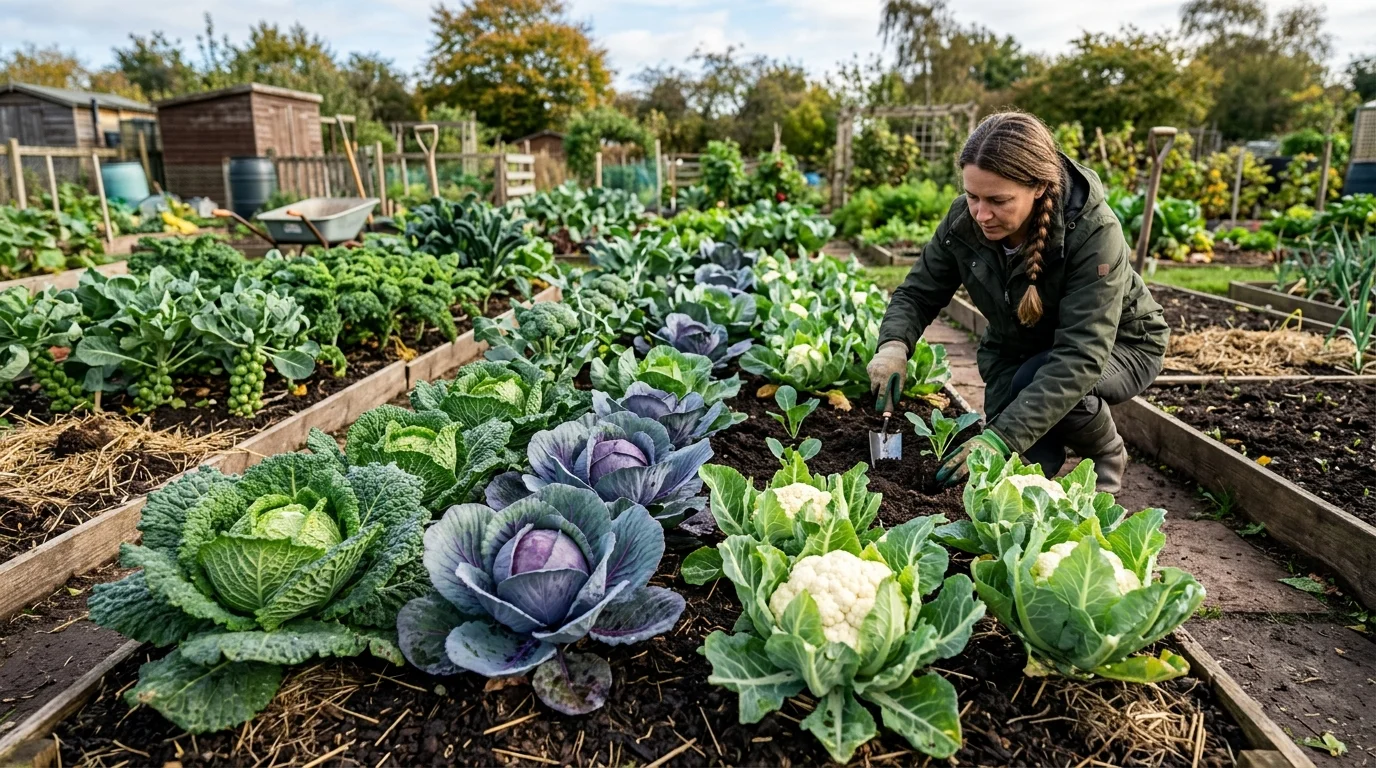
Let’s be honest: brassicas can be a heartbreak on an allotment
You spend weeks nurturing those little seedlings. You harden them off, water them in, and give them a prime spot. Then, overnight, they look like lace doilies. Or they just sit there, turning a sickly purple, refusing to grow. It’s enough to make you swear off cabbages forever.
But here’s the truth: growing brassicas on allotments isn’t about luck. It’s about timing, barriers, and understanding the enemy. I’ve lost whole rows of Brussels sprouts to root fly and watched caterpillars strip a bed of kale in 48 hours. I’ve also learned exactly how to stop it. This isn’t romantic; it’s tactical. And it works.
Let’s break down the three biggest threats to your brassicas—cabbage root fly, caterpillars, and clubroot—and exactly how to manage them. I’ll also give you the lowdown on that trickiest of crops: autumn cauliflowers.
Why your brassicas fail (and it’s rarely your fault)
New plotters often blame themselves. They think they’ve watered wrong or the soil is cursed. In reality, 95% of brassica failures on UK plots are down to preventable pest attack, not poor soil. The specific villains vary by season:
– Spring/early summer: Cabbage root fly lays eggs at the stem base. The tiny maggots eat the roots, and the plant wilts and dies, often looking thirsty when it’s actually being eaten alive underground.
– Late summer/autumn: Cabbage white butterflies lay eggs on leaves. Their caterpillars (the green and black-and-yellow striped ones) can skeletonise a plant in under a week.
– Year-round threat: Clubroot, a soil-borne fungus that swells and distorts roots, stunting growth. Once in your soil, it’s there for decades.
The good news? All three can be managed with consistent, simple strategies. No magic potions, just good habits.
Netting brassicas: your single best investment
If you take only one piece of advice from this article, let it be this: net your brassicas from the moment you plant them out until you harvest them. Don’t wait until you see a white butterfly. By then, eggs are already laid.
Here’s the kit I recommend, based on 15 years of trials on exposed Yorkshire clay:
| Barrier Type | Best For | Pros | Cons | Cost per 10m run |
| — | — | — | — | — |
| Fine insect mesh (0.8mm) | Cabbage root fly, flea beetle, caterpillars | Blocks all pests, allows light and rain | Needs sturdy hoops to prevent sagging | £8–£15 |
| Butterfly netting (10mm) | Cabbage whites only | Cheaper, easy to drape | Does NOT stop root fly or flea beetle | £3–£6 |
| Fleece | Early spring frost & root fly | Warms soil, cheap | Blocks light if left on, tears easily | £2–£5 |
| Enviromesh (pro grade) | All pests + wind protection | Very durable, re-usable 5+ years | Higher upfront cost | £15–£25 |
My go-to method: Use 1.5m lengths of 10mm metal conduit pipe bent into hoops over a 1.2m wide bed. Cover with 0.8mm insect mesh, burying the edges under soil or weighing down with paving slabs. This creates a ‘brassica tunnel’ that I plant into and only lift to harvest. It stops cabbage root fly, cabbage white butterflies, flea beetle, and pigeons in one go.
A common mistake is leaving the netting loose. Gaps at ground level are an open invitation. Root fly females crawl along the soil surface to find stems—they are astonishingly good at finding a 2cm gap. Make it air-tight.
Beating cabbage root fly without chemicals
Cabbage root fly is the stealth killer. You don’t see the fly; you just see your plants collapse. The fly lays eggs in the soil within 5cm of the stem, and the larvae tunnel into the roots over 3-6 weeks.
Here’s the evidence-based strategy:
1. Collars, not collars? The old trick of placing a 10cm cardboard disc (or ‘collar’) around the stem base does work, but only if applied at planting and left undisturbed. The theory is it physically blocks the fly from laying eggs against the stem. In my trials, it reduced damage by 60%—good, but not bulletproof.
2. Mesh beats collars. In a trial by Garden Organic (the UK’s leading organic research charity), fine mesh completely prevented root fly damage. Collars gave partial control. If you have the budget, mesh is the gold standard.
3. Companion planting is weak. I’ve tested planting strong-smelling herbs like sage, rosemary, and tansy around brassicas. It did not reduce root fly damage in any measurable way. Don’t rely on it as your main defence.
4. Biological controls. You can apply nematodes (Steinernema feltiae) to the soil as a drench. These microscopic worms seek out and kill root fly larvae. It works, but it’s expensive for large areas and must be applied when soil temperatures are above 12°C. I use it only for prized autumn cauliflowers if my mesh has a tear.
Verdict: For most plotters, a combination of fine mesh netting + a bed rotation (don’t plant brassicas in the same spot for 3-4 years) is the most practical, cost-effective solution.
Autumn cauliflowers: the high-risk, high-reward crop
Let’s talk about autumn cauliflowers specifically. They are the divas of the brassica world. They need consistent moisture, rich soil, and absolutely no check in growth. A single dry week or a nitrogen shortage, and you get a tiny, button-sized head instead of a proper white curd.
Varieties that work on UK clay:
– ‘All The Year Round’ – Reliable, but needs a long season. Good for September harvest.
– ‘Autumn Giant’ – Large heads, very cold-tolerant. My top pick for October.
– ‘Graffiti’ – Purple variety, sweeter taste. Holds its colour when cooked.
The three rules for success:
1. Plant them deep and firm. Unlike cabbage, cauliflowers need a very firm soil base. After planting, press the soil down hard around the stem. This encourages a tight root system.
2. Feed every 10 days. From planting until the curd starts to form, give a high-nitrogen liquid feed (comfrey tea or a seaweed-based fertiliser). Cauliflowers are nitrogen gluttons.
3. Blanching is a myth (mostly). The old advice to snap leaves over the curd to keep it white only applies to some varieties. Modern varieties often self-blanch. Only do it if you see the curd turning yellow in direct sun—and use a clothes peg, not a snap, to avoid rot.
Pest note: Autumn cauliflowers are particularly vulnerable to cabbage root fly because they are planted in midsummer (June-July) when the fly’s second generation is at its peak. Netting is non-negotiable.
Brussels sprouts: the long game
Sprouts take 6-8 months in the ground. That’s a long time to keep them safe. They are also the most prone to blown (loose, leafy) buttons if they get a check in growth.
My top tips:
– Stake them. On windy plots, tall sprout varieties can rock in the soil, breaking fine root hairs. This stresses the plant. A sturdy cane and a tie solves it.
– Pinch out the top in September. This forces the plant’s energy into the sprouts. Do it when the lower sprouts are pea-sized.
– Blight-resistant? No. Sprouts don’t get potato blight. They get downy mildew in wet autumns. Good air circulation (space them 75cm apart) helps.
The one pest I haven’t mentioned: pigeons
Pigeons are the bane of every allotment. They will strip the leaves off a kale plant in a morning. Netting brassicas is the only reliable solution. Scarecrows work for about 48 hours. CDs on strings work for about an hour. Don’t waste your time.
Frequently asked questions from new plotters
Can I grow brassicas in the same bed as potatoes?
Not if you want to avoid clubroot. Potatoes and brassicas are both in the brassica family? No, wait—potatoes are Solanaceae. But they are heavy feeders. The real issue is rotation. Brassicas follow legumes (peas/beans) best, not potatoes.
My cabbage leaves have yellow patches. What is it?
Probably clubroot. Dig up a plant and check the roots for swollen, distorted lumps. If you find it, remove the plant completely (do not compost it) and avoid planting brassicas in that spot for 7+ years. Lime the soil to raise pH above 7.0, which inhibits the fungus.
When should I plant autumn cauliflowers?
Sow indoors in April-May for transplanting in June-July. They need to be in the ground by early July at the latest to mature before the first hard frosts.
Do I need to net overwintering spring cabbage?
Yes. Cabbage root fly larvae can survive mild winters. Also, pigeons love them in February when other greens are scarce. Net them until you harvest.
Your brassica action plan (the short version)
Here’s the exact sequence I follow on my plot. It’s not complicated, but it’s consistent.
1. Prepare the bed in autumn. Dig in well-rotted manure or compost. Brassicas are hungry. Lime the soil if your pH is below 6.5 (test kits cost £5 from any garden centre).
2. Plant through mesh. From day one. I cannot stress this enough.
3. Water at the roots, not the leaves. Wet leaves encourage downy mildew. Use a drip hose or a watering can with the rose removed, directed at the soil.
4. Feed weekly. Once the plants are established, give a liquid feed every 7-10 days until the head (or sprout) starts to form.
5. Harvest promptly. A cabbage left too long splits. A cauliflower left too long flowers. A sprout left too long opens. Brassicas are not a ‘leave it until you need it’ crop—they have a narrow window of perfection.
Growing brassicas on allotments doesn’t have to be a battle. It’s about setting up the right defences before the problem arrives. Net them, feed them, and give them space. The rest is just patience. And if you lose a few to slugs? Well, that’s what the chickens are for.