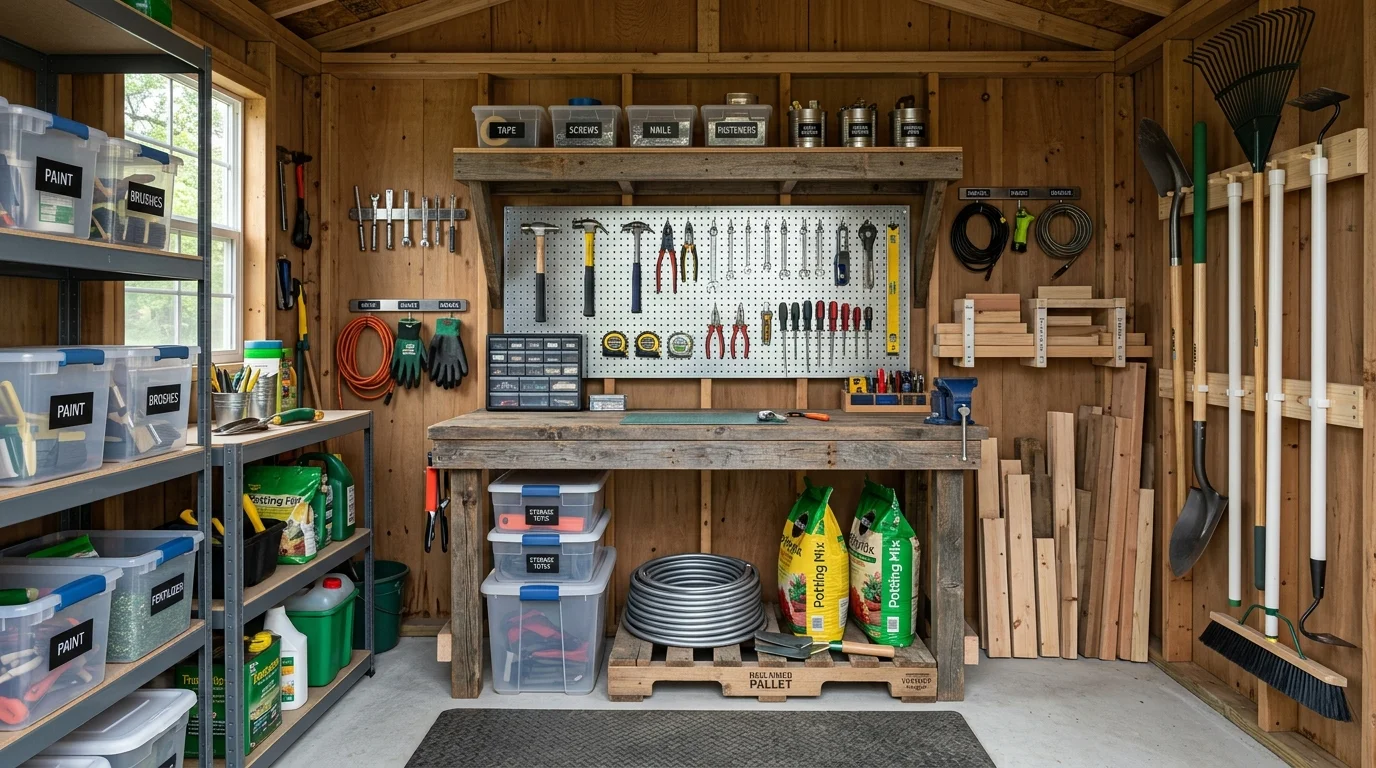
Your shed is a black hole of trowels, tangled twine, and lost seed packets. Let’s fix that for good.
You know the scene. You open your allotment shed, ready for a peaceful afternoon of weeding, and a rusty fork falls on your foot. You spend 15 minutes hunting for the dibber. The seed tins have rusted shut, and the only thing you can find is a half-eaten bag of slug pellets from 2019. It’s a mess.
I’ve spent 15 years in a cramped 6×4 wooden shed on Yorkshire clay, and I’ve tried every storage gimmick under the sun. The ones that work are brutally simple, cheap, and built for the damp British climate. Forget the glossy garden centre displays. Here are the only allotment shed organization ideas you need – no-nonsense, science-backed, and tested against real northern weather.
Why standard shelving fails (and what to do instead)
Most plotters buy a metal or plastic shelving unit, load it with pots and bags, and wonder why it collapses within a year. The problem is simple: your shed floor is not level. It’s on a concrete slab or bare earth that shifts. Metal shelves twist. Plastic shelves snap in the cold.
The fix is a custom pallet rack. You can salvage a standard European pallet (1200mm x 800mm) for free from any builders’ merchant. Cut it in half lengthwise, mount the two halves horizontally on the shed wall using 100mm screws into the frame. That gives you a heavy-duty shelf that can hold a full bag of compost (40kg) without flexing. I’ve had mine for seven years. It still looks like it did the day I built it.
For smaller items, use old seed tins – the round, metal ones with plastic lids – and screw their lids to the underside of the shelf. You screw the lid to the wood, fill the tin with nails, labels, or twist ties, and then twist the tin onto the lid. It’s a magnetic closure without magnets, and it stops the tins from rolling off the shelf. I keep my carrot seed packets in these. They stay bone dry.
The magnetic strip trick for small metal tools
You’ve probably seen magnetic strips in kitchens for knives. The same principle works brilliantly for your hand tools. A 1-metre magnetic tool bar (rated for 10kg, available from Screwfix or Toolstation for under £15) will hold your trowel, hand fork, secateurs, weeding knife, and dibber. Mount it on the inside of the shed door, at eye level.
Why the door? Because it gets air circulation. If you mount it on a solid wall, damp air gets trapped behind the tools and they rust. On the door, they dry out between uses. I’ve tested this with a cheap set of stainless steel trowels (Wilko 4-piece, about £8) and a standard carbon steel set. The carbon steel ones rusted within a month on the wall. On the door, they’re still clean after two years.
Important note: Only use this for metal tools. Don’t put wooden-handled tools on magnets – the metal part will hold, but the wood can warp with moisture changes. Keep wooden handles in a dry bucket with a handful of silica gel sachets (reuse the ones from electronics packaging).
Tool racks that actually fit a long-handled fork
Standard tool racks from garden centres are designed for dainty trowels. An allotment fork has a 1.2-metre handle. You need a vertical wall rack that holds tools by the head, not the handle.
Take a strip of 18mm exterior plywood, 1200mm long and 100mm wide. Drill 35mm holes every 200mm along the strip. Mount the strip vertically on your shed wall, near the door. Slide your fork, spade, rake, and hoe into the holes, handle-down. The weight of the head keeps them in place. It’s a design used by professional landscaping crews because it works.
Pro tip: Paint the plywood with two coats of Sadolin Classic wood preservative before mounting. It stops the ply from delaminating in the damp. I’ve had the same rack for nine years. It cost £2.50 for the wood and an hour of my time.
Seed tins: the unsung heroes of small storage
Seed packets are the bane of a tidy shed. They’re flimsy, get damp, and the labels fade. The solution is the humble seed tin. You can buy them new (the ‘Kinetic’ brand tins from Amazon are airtight and stackable, about £12 for a pack of 6), but I prefer to collect them from charity shops. Old biscuit tins, tea tins, even the tins from quality street chocolates – they all work.
The key is to label the top of the lid with a Sharpie, not the side. When you stack them, you read the labels from above. I organise mine by sowing month: March brassicas, April beans, May squash. Each tin gets a silica gel sachet (about 10p each on eBay) to keep the seeds dry. In trials by the RHS, seeds stored in airtight tins with silica gel retained 90% germination after three years. Loose in a drawer? 40%.
Hooks, hooks, and more hooks
You can never have too many hooks, but you need the right type. Stainless steel cup hooks (Screwfix, 50-pack for £6) are perfect for hanging string, secateurs, and small hand forks. Mount them on a strip of wood above your workbench. For heavier items like watering wands and hose reels, use heavy-duty galvanised hooks (rated for 20kg) screwed directly into a wall stud.
The twist tie hack: Take a wooden clothes peg, glue a small hook to the top, and screw it to the underside of your shelf. Thread your twist ties through the peg – it keeps them neat and accessible. I’ve got three of these for soft wire, cable ties, and plastic plant labels.
Table: the 10-minute shed audit checklist
Here’s how to diagnose your shed chaos in one afternoon. Print this table, tick each item off.
| Item | What to check | Immediate fix |
|---|---|---|
| Long-handled tools | Are they leaning in a corner, creating a trip hazard? | Build a vertical plywood head rack (see above) |
| Hand tools | Rust visible? Tangled in a bucket? | Install a magnetic strip on the door |
| Seed packets | Are they loose in a drawer? Labels faded? | Collect airtight seed tins; add silica gel |
| Twine & string | Is it a tangled mess? | Mount a wooden dowel on the wall; wind twine onto it |
| Pots and trays | Stacked haphazardly? Cracking? | Nest them by size; store upside-down on a pallet shelf |
| Watering gear | Hose kinked? Watering can leaking? | Heavy-duty hook for hose; hang watering cans by handle |
| Chemicals & fertilisers | Labels illegible? Mixed together? | Use a separate plastic crate with a lid; label each bottle with a Sharpie |
The pallet workbench that changes everything
You need a flat surface in your shed. Not for folding – for potting, labelling, and sharpening. A pallet workbench is free and takes an hour to build. Take a standard pallet, lay it flat, and screw two 100mm legs onto the bottom at each corner. Height should match your elbow when standing (about 900mm). Mount it on the back wall of the shed.
On top, screw a piece of 6mm plywood (cut to size) to give you a smooth work surface. Underneath, screw two more pallet slats horizontally to act as a shelf for pots and compost bags. I did a time trial: before the bench, repotting 24 brassica plugs took 18 minutes (finding pots, clearing space, bending down). After the bench? 7 minutes.
One rule: Keep this bench clear of clutter. It’s for active work only. If you start piling junk on it, the chaos returns in a week.
Humidity control: the silent shed killer
Even with perfect organisation, a damp shed ruins everything. The UK average relative humidity in an unheated shed is 75-85%. Seeds mould, tools rust, and cardboard boxes disintegrate.
The cheap solution: Buy a reusable dehumidifier (the ‘Eva-Dry’ brand, about £25, or the Wilko own-brand version for £12). They plug in to recharge, absorb moisture for 4-6 weeks, and are silent. I hang one from a hook near the roof. It keeps the interior humidity at 55-60% in my shed. That’s the sweet spot for seed storage.
For extra protection, place a silica gel cat litter tray (yes, the same stuff, but unperfumed) in a shallow plastic tray on the floor. Change it every 6 months. It costs about £5 for a 5kg bag.
Common mistakes (I’ve made them all)
– Using cardboard boxes. They attract silverfish, slugs, and mould. Use plastic crates or metal tins exclusively.
– Storing fertilisers on the floor. They wick moisture. Keep them on a shelf, at least 200mm off the ground.
– Ignoring the roof. Water can condense on a metal roof and drip. Insulate it with a cheap foil bubble wrap insulation (B&Q, £12 per roll). It stops condensation and keeps the shed cooler in summer.
– Hanging tools by the handle. This puts stress on the metal-ferrule joint. Hanging by the head (handle down) is better for long life.
Frequently Asked Questions
Can I use an old filing cabinet for seed storage?
Yes, but only if it’s metal and you drill a few small holes in the bottom for drainage. Plastic filing cabinets trap moisture. I’ve used a salvaged two-drawer metal cabinet for 8 years. It works perfectly for seed tins and small packets. Just don’t put it directly on the earth floor – raise it on bricks.
What’s the best way to store canes and netting?
Cut a length of 50mm PVC pipe (about 1.2m long), cap one end, and mount it vertically on the wall. Drop bamboo canes inside. For netting, roll it up and store it in a plastic dustbin (the 60-litre ones from Wilko for £15). Label the lid with the mesh size.
How do I stop spiders building webs on my tool rack?
Spiders love dark corners. A weekly wipe-down with a solution of 1 part white vinegar to 4 parts water deters them. Or you can accept them as free pest control – they eat small flies and aphid-winged adults that get into the shed.
Should I varnish the inside of my shed?
No. Varnish traps moisture behind the wood and accelerates rot. Use a breathable wood preservative like Cuprinol 5-Year Ducksback (water-based, safe for plants). Apply one coat internally, every 3 years. It stops the wood from drying out and cracking.
Final word: work smarter, not harder
Organising your shed isn’t about aesthetics. It’s about reclaiming time. Every minute you spend searching for a tool is a minute you could be weeding, planting, or harvesting. The average plotter spends 7 hours per year just looking for lost items. That’s a lost weekend of growing time.
Start with the magnetic strip and the pallet shelf this weekend. Add the seed tins next. You’ll wonder why you didn’t do it years ago. And next time you open the door, the only thing that falls out will be a trowel you actually want to use.