Stop Buying the Wrong Spade. Here’s the Tool Test Your Plot Deserves
You’ve just taken on a 10-rod plot. The soil is a mix of Yorkshire clay and builder’s rubble. You march to the garden centre, grab the cheapest spade on the rack, and within an hour you’ve got blisters, a bent blade, and a back that’s screaming for mercy. I’ve been there. In fact, I’ve broken three spades in my first year alone. The right tool isn’t a luxury—it’s the difference between enjoying your plot and quitting by June.
Let’s strip this down to the science and the sweat. There is no ‘one-size-fits-all’ spade, but there is a right spade for your soil, your body, and your budget. Here’s how to choose the best allotment spade without wasting a penny.
First, Know Your Enemy: Soil Type Dictates Steel
Before you even look at a handle, dig a test hole. The material your spade is made from must match the ground you’re working.
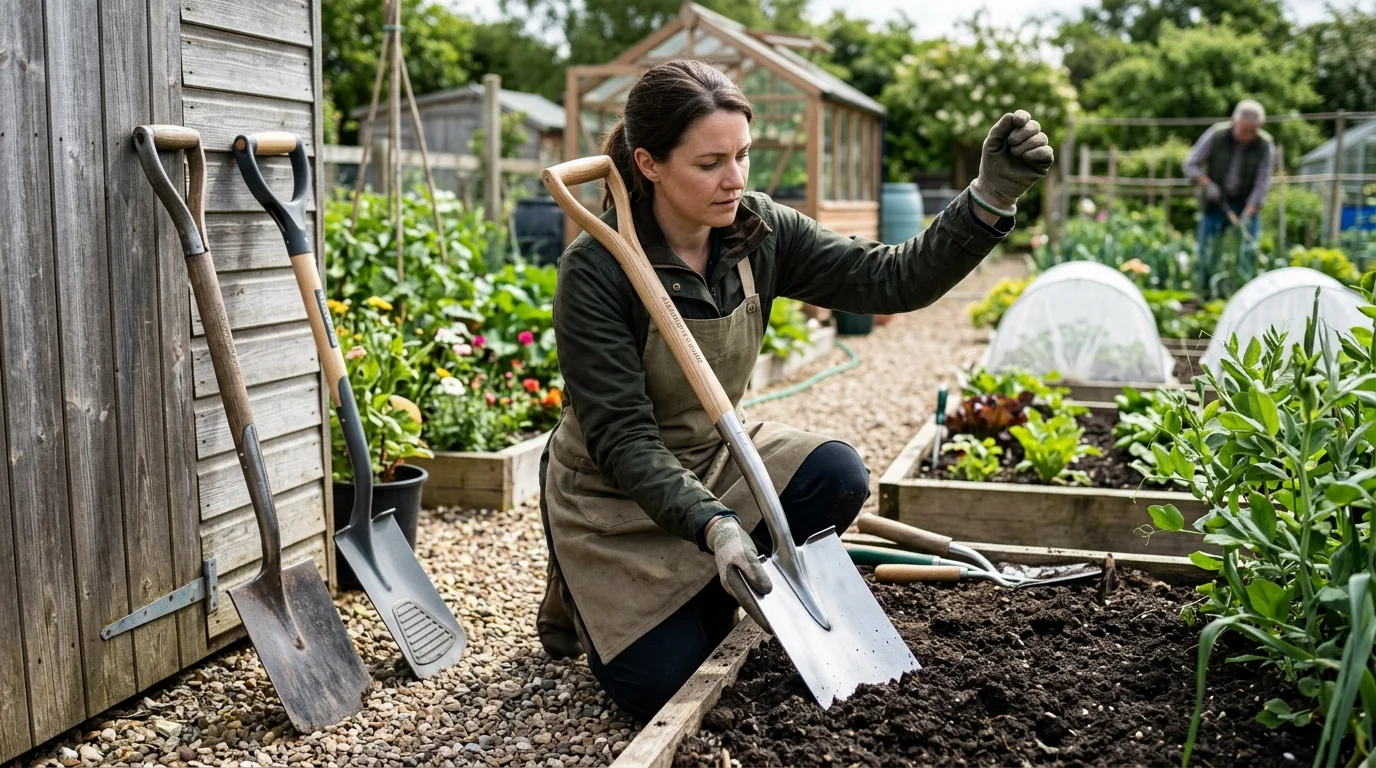
Stainless Steel (e.g., Burgon & Ball or Spear & Jackson)
– Best for: Heavy clay, stony ground, wet conditions.
– Why: Stainless steel doesn’t rust. It slides through sticky clay with less friction. I use a stainless border spade for my raised beds because it cleans off with a wipe—no wire wool needed.
– Downside: It’s more expensive and can be slightly brittle if you lever against rocks. But for long-term use on a typical UK allotment, it’s the gold standard.
Carbon Steel (e.g., Bulldog or Fiskars Solid)
– Best for: Sandy loam, lighter soils, budget-conscious growers.
– Why: Carbon steel is tough. It can take a beating and you can sharpen it to a razor edge. It’s also cheaper.
– Downside: It rusts fast. Leave it in the rain overnight and you’ll see orange streaks by morning. You must oil it after every use. Many thrifty growers love it, but only if they’re disciplined.
How I Test It: Take a magnet to the shop. Stainless steel is non-magnetic (or weakly magnetic). Carbon steel sticks hard. If the magnet barely holds, you’re buying quality stainless.
The Handle: Your Back Will Thank You Later
This is where most new plotters go wrong. They buy a spade with a handle that’s too short or the wrong shape. Here’s the breakdown:
| Handle Type | Best For | Watch Out For |
|---|---|---|
| Traditional ‘D’ or ‘T’ Grip | General digging, turning over beds. Gives you leverage for pushing down with your foot. | Can rub blisters on the palm if not ergonomic. Look for a cushioned grip. |
| Y-D Handle (Ergonomic) | Gardeners with arthritis, wrist pain, or back issues. Aligns your forearm with the shaft. | Heavier. Makes it harder to twist the spade for lifting. Test before buying. |
| Long Handle (Straight Shaft, no cross-grip) | Digging deep beds, leverage for breaking clay. Common on professional tools. | Requires more arm strength. Less control for precision work. |
My rule of thumb: The spade should reach your waist when stood upright on the ground. Any shorter and you’ll stoop. Any longer and you lose control. For a 5’6” to 6’0” person, a 28-inch shaft is ideal. For shorter growers (under 5’4”), look for a 26-inch shaft.
Weight: Don’t Let ‘Tough’ Fool You
A heavy spade (over 2.5 kg) will exhaust you in 20 minutes. A light spade (under 1.8 kg) might not have the strength to break compacted soil. The sweet spot is between 1.8 kg and 2.2 kg.
How to test in the shop: Hold the spade at arm’s length for 10 seconds. If your wrist starts to ache, it’s too heavy. If you can hold it for 30 seconds, it’s fine. I’ve seen strong men buy 3 kg ‘digging monsters’ and sell them within a month. Your allotment is a marathon, not a sprint.
Blade Shape: Treaded vs. Plain
You’ll see spades with a flat top (tread) for your boot. This matters more than you think.
– Flat tread: Good for general digging. Your foot sits securely.
– Rounded or ‘heart-shaped’ tread: Classic look, but your foot can slip, especially in wet mud. Avoid if you have weak ankles.
– Pointed blade: Best for breaking new ground, cutting through roots, or edging. Pointed tips concentrate force.
– Square blade: Better for moving loose soil, compost, or shaping beds.
For a typical allotment with mixed soil and some perennial weeds, I recommend a rounded square blade with a flat tread. It’s the most versatile.
Don’t Forget the Fork: Why You Need Both
A spade alone won’t save you. For digging, you need a digging fork alongside your spade. Here’s the difference:
– Spade: For cutting turf, edging beds, moving soil, planting holes.
– Digging Fork (4-prong): For loosening compacted soil, lifting root crops (potatoes, parsnips), breaking up clay without shearing it.
I use my fork 60% of the time. The spade is for finishing. If you only buy one tool, buy a fork. But for most plotters, you need both. Look for a fork with forged tines (not welded) to avoid snapping.
Three Spades I Recommend (and One to Avoid)
Based on 15 years of trialling, here are my honest picks:
- Burgon & Ball ‘RHS Endorsed’ Stainless Steel Digging Spade (approx. £55): Excellent stainless steel, ergonomic Y-handle option, lifetime guarantee. I’ve had mine for 8 years. Best for clay.
- Bulldog Carbon Steel Digging Spade (approx. £40): Tough as nails. Perfect for light soil or if you maintain tools well. Heavy (2.3 kg) but durable.
- Fiskars Solid Spade (approx. £45): Fibreglass shaft, lightweight (1.7 kg), and the blade connection is reinforced. Ideal for new plotters with average soil.
- Avoid: Any supermarket own-brand spade under £15. The blade bends, the handle splits, and you’ll replace it within a season. False economy.
For more independent testing, the RHS recommends tools that meet their rigorous ergonomic and durability standards. You can read their full tool guide on the RHS Equipment Advice Page. Additionally, Garden Organic has detailed trials on fork versus spade use in no-dig systems at Garden Organic’s Research Hub.
How to Choose the Best Allotment Spade in 3 Steps
- Diagnose your soil. Heavy clay = stainless steel. Sandy loam = carbon steel.
- Match the handle to your height and body. Y-handle for bad backs; traditional D-grip for general use.
- Lift it in the shop. If it feels heavy after 10 seconds, put it back. Aim for 1.8–2.2 kg.
FAQ: Your Spade Questions Answered
Should I buy a spade with a wooden or fibreglass handle?
Wooden handles (ash) are classic—they absorb shock well and feel warm to the touch. But they can rot if left wet. Fibreglass handles are lighter, rot-proof, and often ergonomic. I prefer fibreglass for longevity on a wet plot, but ash is fine if you store it dry.
Can I use a digging fork instead of a spade?
For loosening soil and lifting crops, yes. For edging, cutting turf, or moving compost, no. You really need both. Many no-dig plotters use only a fork, but they rarely break new ground. If you’re starting a plot from scratch, a spade is essential.
How do I maintain my spade?
Clean after every use. For stainless steel: just hose off. For carbon steel: dry and rub with linseed oil. Sharpen the blade edge once a year with a file. Never leave it in the ground—bending the blade weakens the steel.
The Final Word
Choosing the best allotment spade isn’t about buying the most expensive or the prettiest tool. It’s about knowing your ground and your body. I’ve seen plotters with £10 spades work wonders because they matched it to their light soil. I’ve also seen £80 spades snap on heavy clay because the handle was wrong.
Grow smarter, not harder. Test the spade in-store, prioritise stainless for clay, and remember that a digging fork is your secret weapon. Your back—and your harvest—will thank you.