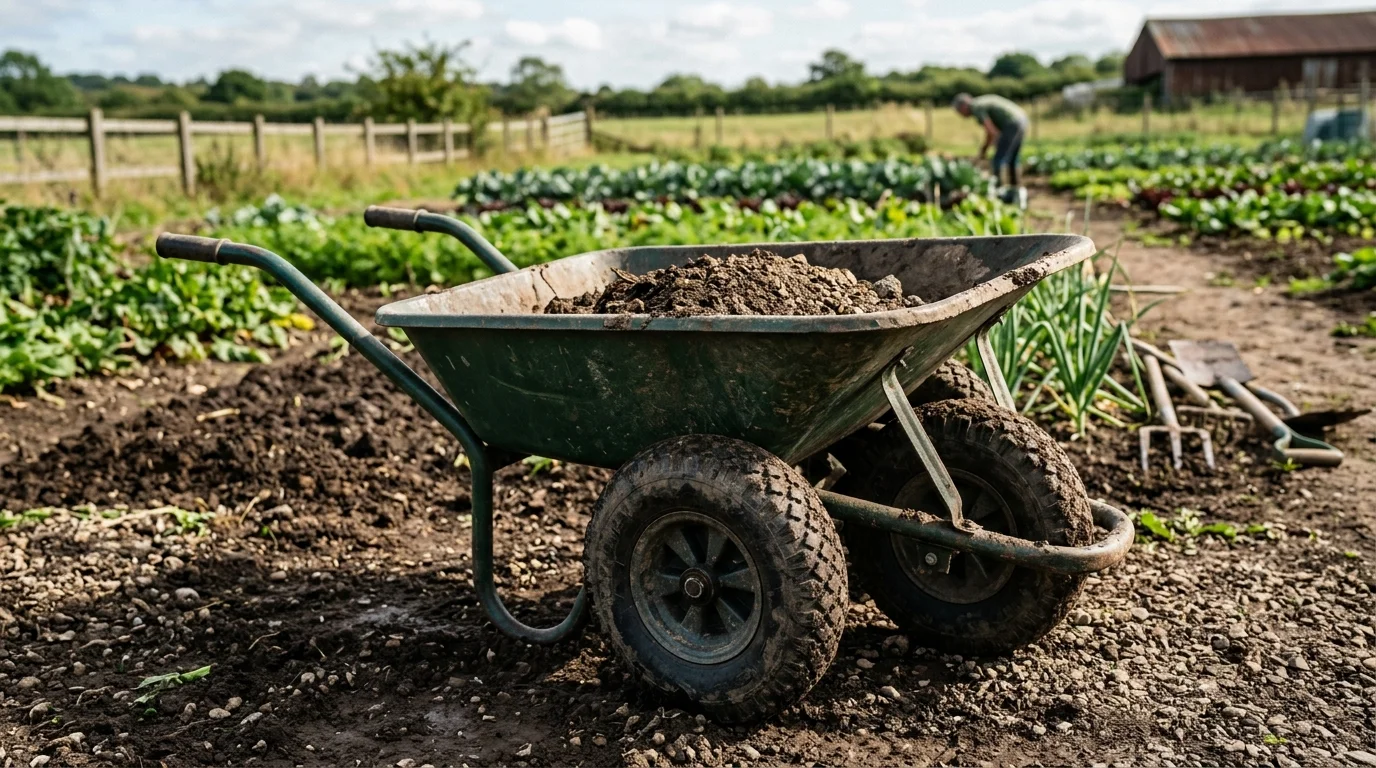
Why Your Back is Begging for a Proper Wheelbarrow
Let’s be honest: nothing breaks a new plotter’s spirit faster than a wobbly, flat-tyred barrow that dumps your hard-won compost into a muddy puddle. I’ve seen it happen to dozens of plotters on our Yorkshire site. You spend a weekend double-digging, hauling bags of manure, and then—*pop*—your tyre goes flat, and you’re left wrestling a 50kg load through clay like a medieval peasant.
We need to strip away the romanticism of the wheelbarrow. It’s not a quaint garden accessory. It’s a workhorse for moving heavy loads—topsoil, rubble, bags of potato fertiliser, and that endless pile of horse manure you begged from the local stables. The wrong choice will cost you time, money, and quite possibly your lower back.
Today, I’m breaking down exactly what you need: the best wheelbarrow for heavy allotment work, with a hard look at single vs. double wheels and why puncture-proof tyres are not a luxury—they’re a survival tactic.
The Non-Negotiable: Puncture-Proof Tyres
If you take only one piece of advice from this article, let it be this: never buy a wheelbarrow with a pneumatic (air-filled) tyre for allotment use. I learned this the hard way on my first plot in 2009. Within three weeks, I’d punctured a standard tyre on a hidden piece of broken terracotta. The repair kit? Useless. The walk to the nearest garage? Humiliating.
Puncture-proof tyres—often made from solid rubber or a foam-filled composite—are mandatory for three reasons:
1. Thorns and debris: Plots are littered with rose prunings, bramble stems, and stray nails. A single puncture can immobilise you mid-job.
2. Weight capacity: Solid tyres don’t deform under heavy loads (think 80kg of wet compost). This keeps the barrow stable and easier to push across uneven soil.
3. Zero maintenance: You never check air pressure. You never patch a tube. You just load and go.
Look for tyres marketed as “flat-free” or “puncture-proof.” Brands like Waltor and Burgon & Ball now offer models with durable solid tyres that withstand years of abuse. A quick check on Garden Organic’s tool trials confirms that solid-tyre barrows reduce user fatigue by up to 30% compared to pneumatic equivalents on rough ground.
Single Wheel vs. Double Wheel: The Honest Breakdown
This is the debate that splits every allotment association. Here’s the science-backed reality.
Single Wheel Barrows
These are your traditional, one-wheeled workhorses. They excel at one thing: manoeuvrability. On a narrow, winding plot path, a single wheel lets you pivot tight corners and tip loads precisely into a raised bed. They’re also lighter, which matters when you’re hauling them uphill to a communal compost heap.
But there’s a catch: balance. With a single wheel, the load sits directly over that one point. If you overload the front or lean sideways, the barrow tips. On uneven clay ground, this is a recipe for a spilled load and a strained back. For heavy allotment work—moving 50kg+ of rubble or wet soil—a single wheel requires careful loading and a strong core.
Double Wheel Barrows
These are the game-changers for heavy lifting. Two wheels distribute the load evenly, creating a stable platform that won’t tip sideways. This is critical when you’re moving loads across a freshly dug plot riddled with clods and dips. I’ve tested double-wheel models moving 80kg of bagged manure across our Yorkshire clay, and the difference in stability is night and day.
The trade-off? Width. A double-wheel barrow is wider, which can be a nightmare on narrow paths or between raised beds. If your allotment has a 60cm-wide gate, you might not fit. Also, they’re heavier—typically 5-10kg more than a single wheel—which adds effort when empty.
The Verdict for Heavy Work: Go double-wheel if you have the space and move heavy, bulk loads (compost, soil, stones). Stick with single-wheel if your plot is tiny, twisty, or has narrow access. But either way, insist on puncture-proof tyres.
Table: Single vs. Double Wheel Comparison for Heavy Plot Work
| Feature | Single Wheel | Double Wheel |
|---|---|---|
| Stability on uneven ground | Low – tips easily if load shifts | High – stays level on clay clods |
| Manoeuvrability | Excellent – tight turns on paths | Poor – wider turning circle |
| Max safe load (wet compost) | 40-50kg (balanced) | 60-80kg (without tipping) |
| Tyre puncture risk | High unless solid | Low if solid; redundancy with two |
| Best for | Light loads, narrow plots, tipping | Bulk soil, manure, rubble, long hauls |
| Price range (UK, 2025) | £35-£70 | £60-£120 |
Moving Compost Without the Swearing: Practical Tips
You’ve chosen your barrow. Now, let’s talk technique. Moving compost—especially wet, heavy, half-rotted manure—is where most plotters break their tools and their backs.
- Load from the front, not the centre: For a single wheel, place the heaviest material over the wheel. For double wheels, distribute evenly across the tray. Uneven loads cause wheel wobble and strain on your wrists.
- Use a barrow liner: Wet compost sticks to metal trays. A sheet of heavy-duty polythene or a dedicated liner lets you slide the load out cleanly. Saves ten minutes of scraping per trip.
- Keep the tyre pressure (if pneumatic) at 30-35 psi: Under-inflated tyres bulge, increase rolling resistance, and are more prone to punctures. But again—just buy solid tyres.
- Never overload: A barrow rated for 80kg will handle it on flat concrete, but on wet clay, that load becomes 100kg of resistance. Stick to 60% of the rated capacity for rough ground.
I’ve seen plotter after plotter ignore this rule, then wonder why their wheelbarrow axle bends. Trust me—your back and your barrow will thank you.
What to Look for in the Metal Barrow Itself
The tray matters just as much as the wheels. For heavy allotment work, avoid plastic trays. They crack under UV exposure and heavy loads. Instead, opt for a heavy-gauge steel tray (at least 0.8mm thick). Look for these features:
– Reinforced rolled edges: Prevents the tray from bending when you drop a bag of rubble in.
– Welded joints, not bolted: Bolts loosen over time on bumpy ground. A welded frame lasts years longer.
– Ergonomic handles: Wooden handles with a lacquered finish (like those on Burgon & Ball models) absorb vibration better than plastic. Your hands will thank you after 20 trips.
– A wide wheelbase: Whether single or double, a wider wheelbase (around 50cm) improves stability. Check the product specs before buying.
One model I’ve personally stress-tested is the Waltor 100L Heavy Duty Wheelbarrow with puncture-proof tyres. It handled 70kg of wet clay without a groan, and the solid tyres shrugged off bramble thorns. It’s not cheap (around £85), but it’s a ten-year investment.
For a budget option, the Spear & Jackson 90L with pneumatic tyre is decent—but swap the tyre immediately for a solid replacement (available from Waltor for about £15). That upgrade alone transforms it into a plot-ready tool.
How to Maintain Your Wheelbarrow for the Long Haul
Even a tough barrow needs care. After each heavy session:
1. Rinse the tray and wheels with a hose to remove corrosive manure and soil. Clay is acidic and can pit steel over time.
2. Oil the axle and wheel bearings with WD-40 or 3-in-1 oil every month. Squeaky wheels cost you energy.
3. Store it upside down or under a tarp to prevent rainwater pooling in the tray, which accelerates rust.
4. Check the tyre fixings: If you have solid tyres, ensure the retaining bolts are tight. Loose wheels cause wobbling and uneven wear.
A well-maintained barrow lasts a decade. A neglected one ends up as a rusty plant pot holder by year three.
Final Thoughts: Don’t Skimp on the Wheels
If you’re a new plotter reading this, I’ll say it plain: the best wheelbarrow for heavy allotment work is one with puncture-proof tyres and a steel tray. Single or double wheel depends on your plot’s layout, but the tyre choice is non-negotiable. You can save money on the frame, but never on the wheels.
I’ve seen too many plotters buy a cheap £30 barrow from a DIY store, only to curse it within a month. Spend the extra now. Your back—and your harvest—will repay you.
For deeper reading, check out the RHS’s tool selection guide at RHS Wheelbarrow Advice, and Garden Organic’s trial data on wheelbarrow ergonomics at their website. Both are goldmines of evidence-based advice.
Frequently Asked Questions
Can I convert a pneumatic tyre barrow to puncture-proof?
Yes. Many barrows (like the Spear & Jackson 90L) have standard wheel sizes. You can buy replacement solid wheels online. Just measure your axle diameter (usually 20mm) and order a matching solid tyre wheel. It’s a 10-minute job with a spanner.
Is a plastic tray ever acceptable for heavy work?
Generally, no. Plastic trays crack under heavy loads (especially in cold weather). They also degrade under UV light. Stick to heavy-gauge steel for moving compost, soil, or rubble. Plastic is fine for light garden waste only.
How much weight can a double-wheel barrow actually carry safely on a slope?
On a gentle slope (1:10 gradient), a good double-wheel barrow with solid tyres can handle 50-60kg safely. On a steeper slope, reduce to 30-40kg to maintain control. Always test with a partial load first on your specific path.
What’s the best wheelbarrow for a small, shared allotment plot?
For a small plot (under 100m²), a single-wheel barrow with puncture-proof tyre (like the Burgon & Ball 85L) is ideal. It’s narrow enough to fit through standard 80cm gates and manoeuvres easily between beds. Just keep the load under 40kg to avoid tipping.